
An invention for education
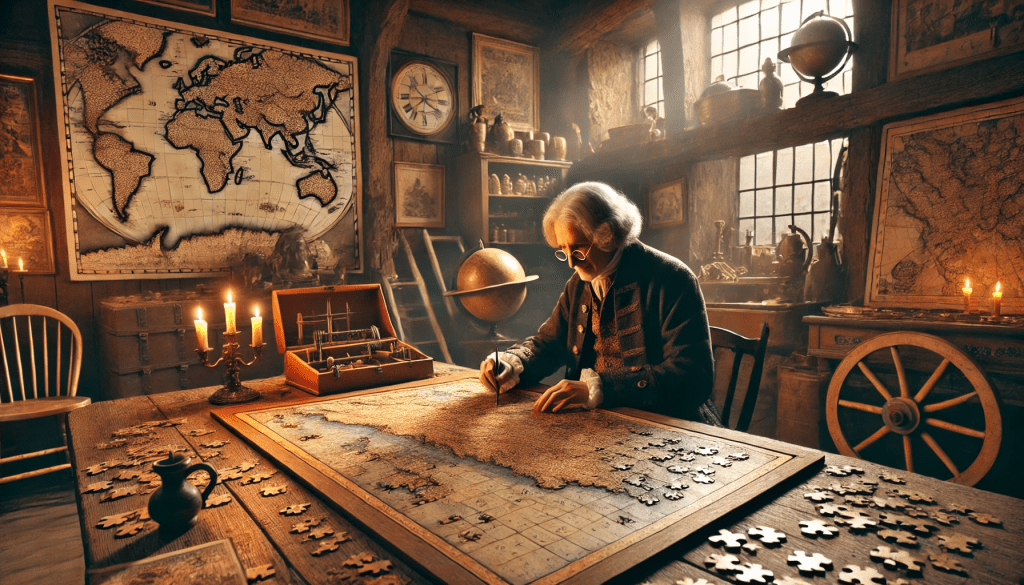
In 1766, the British cartographer John Spilsbury had the ingenious idea of cutting a geographic map into pieces to make it an educational tool. Each coin represented a region or country, and the purpose was to replicate the complete map. This object, known as the ⁇ dissected map, was used to teach geography to children in an interactive way. At the time, traditional schools used much more rigid methods, and this playful approach was revolutionary.
Imagine an 18th-century student: instead of an austere picture, he manipulates the pieces of a map to understand where the continents are. A much more engaging method than mere oral lessons. This innovation immediately attracted wealthy families, and Spilsbury marketed his puzzles as a must-have educational tool.
From learning to leisure
It was not until the 19th century that puzzles began to become democratized and a real pastime. With the advent of industrial printing techniques and cutting machines, their production has become faster and more affordable. The patterns are diverse: landscapes, works of art, animals… They are no longer confined to geography.
As their popularity increases, so do puzzles. We’re moving from wooden versions to cardboard puzzles, cheaper and more accessible to a wider audience. During the Great Depression of the 1930s, puzzles in the United States experienced a dramatic rise. In times of crisis, these games provide a cheap and captivating diversion, a way for families to get together around a common activity.
A Challenge to the Mind
What makes puzzles so unique is their ability to stimulate the brain while providing deep satisfaction. Solving a puzzle is a complex activity that involves several cognitive functions: visual recognition, memory, problem solving and even motor coordination.
Take the example of the Ravensburger puzzles. These perfectly cut pieces are almost scientifically accurate. When you put together a scene like a forest under the northern lights, each piece becomes part of a living painting. This process combines concentration, patience and intuition, qualities that few other leisure activities require at this level.
In addition, puzzles transcend generations. Whether you’re a six-year-old child discovering his first 100-piece puzzle or an adult passionate about a 5000-piece puzzle, the experience remains universal.
Why Puzzles Are Still Attractive Today
In our saturated digital age of screens, puzzles offer a welcome break. They embody an active form of meditation. Far from incessant notifications, they reconnect us to a simple but deeply enriching activity.
Another factor in their success is their diversity. Today, puzzles are offered in infinite forms: 3D puzzles, personalization puzzles from photos, phosphorescent puzzles… Some, like those for competitions, even aim to test the speed and accuracy of the participants.
Finally, puzzles are part of a wider movement towards a return to manual leisure. Like knitting or pottery, they value the time spent creating something tangible. Every coin found and adjusted in the right place becomes a victory. A metaphor for patience in a world that often advocates immediacy.
A Time-Old Popularity
From 18th-century classrooms to 21st-century living rooms, puzzles have kept reinventing themselves. Their longevity comes from their ability
The puzzles are not just objects, they tell a story, that of a humanity that seeks to understand, organize and build. An activity that, despite centuries, remains as fascinating as it was on the first day.

Échanger autour de cet articleUne question ou une expérience à partager ?