A saw at the heart of the evolution of puzzles
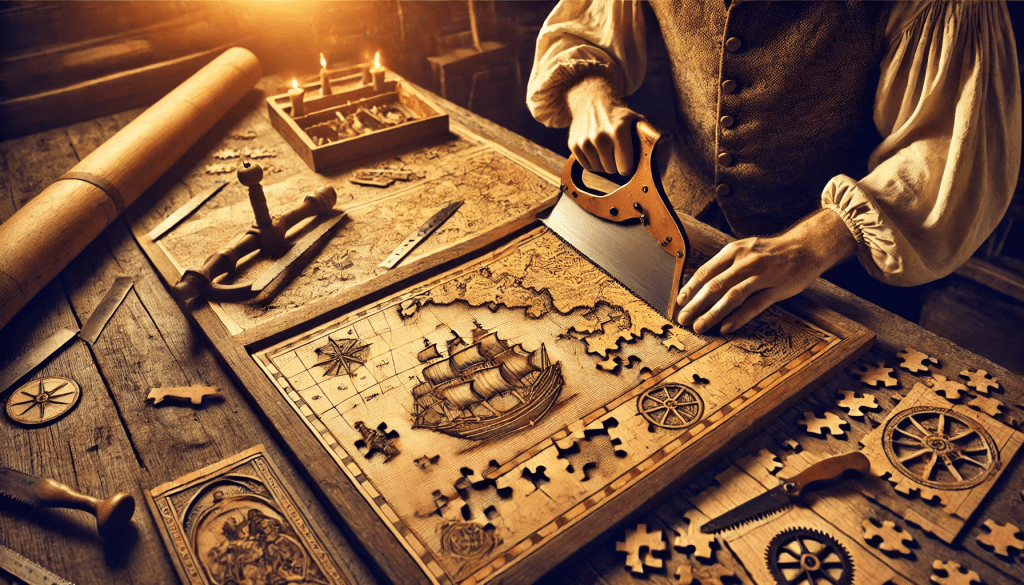
Originally, modern puzzles, such as those invented by John Spilsbury in the 18th century, were handmade from wooden plates. These early versions, known as ⁇ dissected maps ⁇ , were mainly educational tools. But to cut the different pieces, the craftsmen needed a precise tool capable of following complex curves and creating unique shapes.
That’s where the singing saw, or jigsaw in English, comes in. This saw, fitted with a fine blade mounted on a frame, allowed detailed patterns to be cut with great precision. Imagine a map of Europe engraved on a wooden board: to separate borders from countries without distorting them, artisans used the saw to sing to follow the lines faithfully. This tool has transformed the way puzzles are made, offering more varied shapes and a more complex gaming experience.
Over time, the link between the saw and the puzzle became so strong that the word 的jigsaw , was directly associated with the finished product. This term has passed through generations to designate what we know today as the 的jigsaw puzzle ,
A revolution in manufacturing
The introduction of the singing saw marked an important step in the evolution of puzzles, but it was not the only factor. In the 19th century, wooden puzzles, though popular, were still expensive and reserved for the elite. To make them, skilled craftsmen were needed who could handle the saw to make them accurate.
However, with the advent of cheaper materials such as cardboard and the industrialization of cutting processes, puzzles have become accessible to a wider public. Ironically, as technology evolved, the saw was gradually replaced by faster, more efficient machines. But the linguistic heritage has remained. Even today, while most puzzles are made from pressed cardboard plates, the term jigsaw puzzle continues to reflect this artisanal origin.
Why That Word Still Matters
What is fascinating with the term 的jigsaw puzzle , is that it perfectly illustrates the transition between crafts and industry. It reminds us of a time when each piece was hand-cut, with meticulous attention to detail. Although modern tools have simplified the process, the spirit of the word remains.
Furthermore, the word ⁇ jigsaw ⁇ also embodies the very challenge that a puzzle presents. Like a carpenter who follows a curve with his saw, putting together a puzzle requires precision, patience, and a keen eye for detail. It is this demand, combined with the pleasure of seeing a complete picture forming piece by piece, that continues to captivate millions of people around the world.
A word for everyone
Today, the word ⁇ jigsaw puzzle ⁇ is used far beyond English-speaking borders. In languages such as French, German or Spanish, the term English is often retained to refer to this type of puzzle. This reflects not only the influence of the English language but also the way in which the word has become a universal symbol.
Even in digital contexts, where virtual puzzles are proliferating, the term “jigsaw puzzle” remains an essential reference. These modern adaptations, while removed from saws and workshops in the past, retain this spirit of methodical assembly and search for perfect fit.
The Commission
The word “jigsaw puzzle” is much more than just a label. It is a rich history of a carpenter’s tool that opened the way to a world-wide hobby. Although the singing saw is no longer the center of production, its imprint remains engraved in our language and collective memory. Every time you put together a puzzle, you’re part of a long tradition that combines craft, innovation and shared fun.

Échanger autour de cet articleUne question ou une expérience à partager ?