How to choose your first battles
Forget the puzzle 1000 pieces with monochrome forest motif: if you start, start small, but strategic. 300 or 500 pieces, with distinct zones, sharp contrasts, varied textures. You need a visual marker, a relief, a pattern that’s easy to remember. A puzzle with a red cup, blue sky, a scratched cat, is a treasure map for beginners.
Take a time, but don’t beat yourself up at the second. The idea is not to break a world record from the first attempt, but to understand your own logic of resolution. Some people will assemble the pieces by texture, others by color, others by shape. You have to watch how your brain sortes information: your speed will come not by copying a method, but by matching yours.
The organization: more tactical than technical
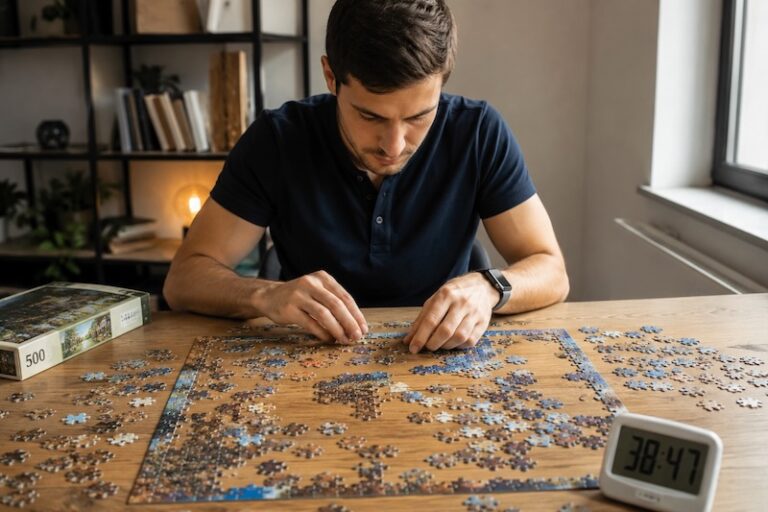
The first few minutes of a speed puzzle are crucial. They’re the ones who condition everything else. Forget the romantic impulse of I start where I want to start. You need a protocol. Spread out all the pieces, face visible. Yes, all of them. A game that’s turned is like a player missing on a field: it slows down the team. Then, immediately separate the edges. Building the frame is mapping the battlefield.
What about the rest of the pieces? Three minimum trims: by dominant colour, recognizable pattern and atypical shape. A room with a fluid stain or a panda’s eye will split immediately. The real secret here is not precision, it’s intention. The sorting is an investment: it costs you 5 minutes at the beginning, but it saves you 15 minutes at the end. The one who tries the wrong way will have to search each coin three times.
At home, train yourself to reproduce these gestures automatically. The effective speed puzzler does not think, it executes. Each action must become a reflex. The real level is measured not in minutes won, but in useless movements eliminated.
Learning to Stay Conscious Under Pressure
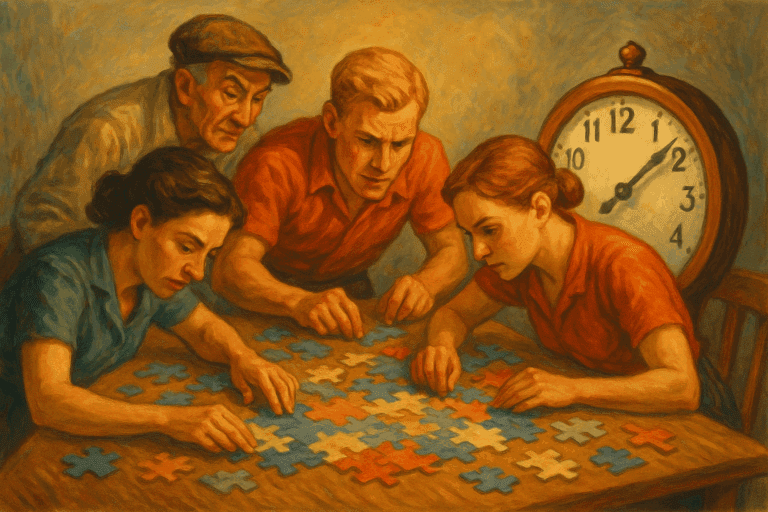
The day you do your first competition, there’ll be noise. Nervous laughs. Short breaths. Hands that tremble on the first pieces. And a clock that makes a tactile noise in a corner of your head. You thought the puzzle was a zen moment? Get out of the way. Here, serenity is a luxury, but it’s also a weapon.
Breathe. Avoid blocking on a single section. The classic mistake of the beginner is to sting on a zone too early. If it doesn’t come back after 20 seconds of attempt, change the coin. Learn to give up quickly to get back in later. In speed puzzle, pride costs time.
Your gaze must sweep the table constantly. A good puzzler sees all at the same time: the pieces, the voids, the possible connections. It is a dynamic reading of space. You must learn to see without fixing.
And if you’re in a team, don’t talk to furniture. Talk to move forward: green tips up, textured parts left, missing a round here. It’s a factory coordination, not a lounge discussion.
Understanding the format, avoiding traps
Not all competitions are the same. Some of them are silent, others are allowed music. Some provide puzzles to the blind, others announce the mark in advance. Read the regulations like you’re preparing for an exam. A team that doesn’t know that they have to put the puzzle in the box once it’s done can lose its victory over a formality.
The furniture also counts: table height, ambient light, size of the puzzle provided. When training, vary the conditions. Learn how to adapt to the unstable. A good speed puzzler does not collapse because a lamp is missing or it is sitting in the cross.
Finally, know that the puzzle provided can be deliberately disturbing: uniform sky, abstract patterns, trapous pieces. It is not a pure logic test, it is a cold blood test.
Progress is repeating
Do not fall into the trap of marathon training. Making a 3h puzzle every Sunday will not make you fast. What you need are short, frequent, and targeted sessions. 30 minutes to make the frame. 30 minutes to sort an unknown puzzle. 20 minutes to complete a precise pattern area.
Work your part time as a runner works his sprints. Write down your scores. Repeat the same puzzles. It’s by knowing your faults that you erase them. A known puzzle becomes a field of experimentation: what if you test a new sort? Another arrangement? A reverse approach?
Starting with speed puzzle is not just about to start: it’s about learning to choose, to repeat, to think quickly and to decide even faster. The puzzle won’t wait for you. The time is even less.
Échanger autour de cet articleUne question ou une expérience à partager ?