But to understand the history of the speed puzzling, you have to switch to another time frame, the race against the clock. And this simple idea — to finish a puzzle as soon as possible — comes not from a toy manufacturer, but from a Midwest woman.
Betty McGregor, the American spark
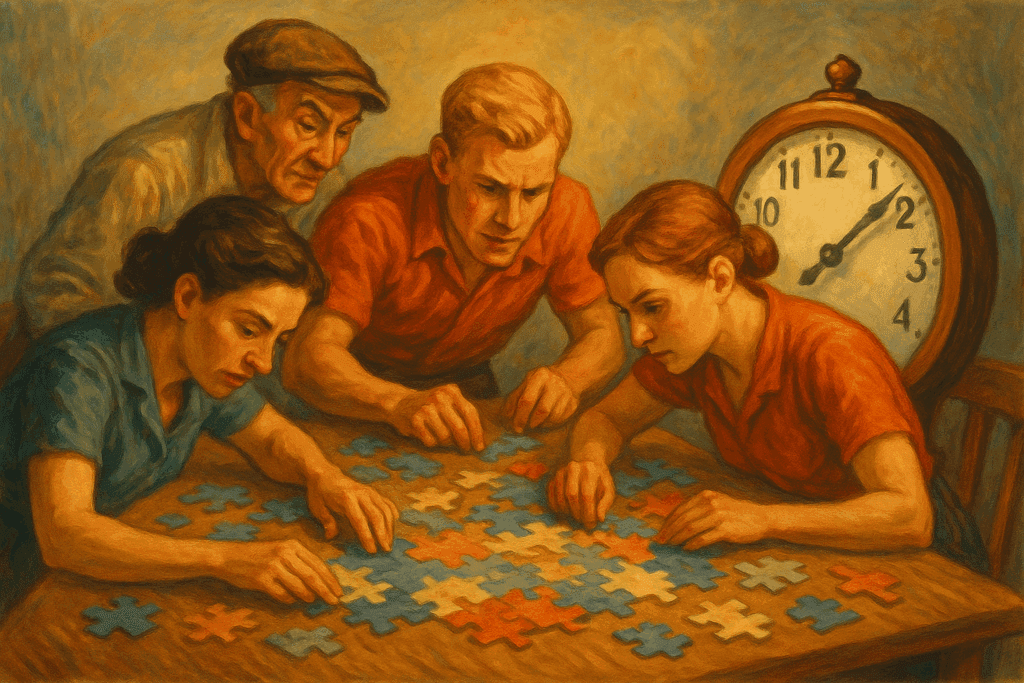
Minnesota, 1946 Betty McGregor, a newlywed, loves to throw games. Her husband, who is less a fan of these long puzzle sessions with friends, offers a compromise: play, yes, but with a time limit. Betty puts a clock on the table. Unbeknownst to her, she has just invented a format that will go on for decades: time-based puzzle.
Every Tuesday, she opens her house to strangers and friends for puzzle duels. The rule is simple: a box, a timer, silence, then hands activate. It’s friendly, but it’s also a competition. Quickly, word of mouth is doing its job. Other families imitate the format. Small competitions are organised in kitchens, garages, community centres. The puzzle, long thought of as a meditation activity, becomes a test of speed and concentration.
The evolution to sport
It takes time to break out of amateur circles. It takes until the end of the 20th century for speed puzzling to come out of anonymity. The first organized tournaments appear modest but structured. These are often local events, organised by libraries, clubs or schools. The rules are clear: time limit, puzzles of the same size, prohibition on sorting the pieces in advance. The audience is diverse, intergenerational. A grandmother can beat a teenager, a mother of the family can compete with a student. No need for a particular physique, just a sharp eye, a fearsome visual memory, and an Olympic calm.
Puzzle brands are interested in the phenomenon. RavensburgerSome of the events are beginning to be sponsored by Cobble Hill, Educa. Marketing follows: “Jigsaw sports” is a “jigsaw racing puzzle”. The discipline is still niche, but it is beginning to trace its path, especially in Anglo-Saxon countries.
The international structuring
The major turning point came in 2019 with the creation of the The World Jigsaw Puzzle Federation (WJPF)His goal is: make puzzles competitions a sport The project is serious: standardisation of regulations, record recognition by the Guinness World Records, networking of national federations, organisation of world championships.
Ambition goes beyond performance: it is also about enhancing the benefits of the puzzle on cognitive health, socialization and concentration. The puzzle is no longer just a rainy Sunday activity, it’s a mental training ground. The official competitions now feature hundreds of participants from dozens of countries. The formats vary: individual, duo, team of four, in 500 or 1000 pieces, with unknown puzzles to be discovered in real time.
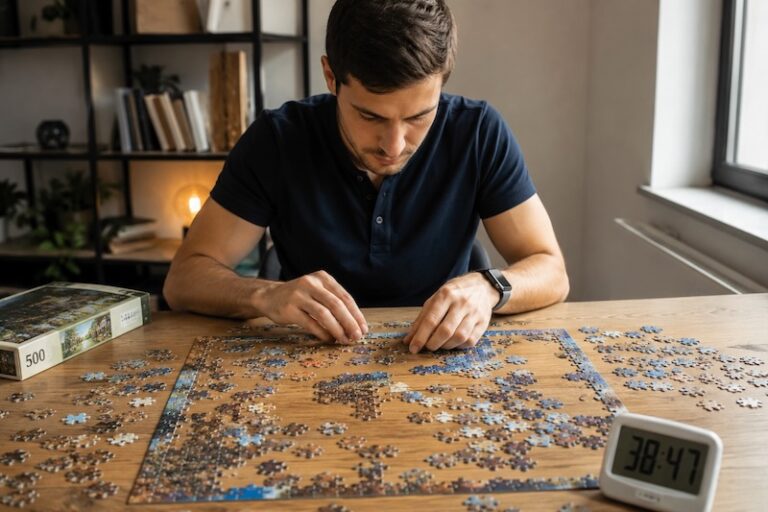
A world record ? Complete a 500-piece puzzle in less than 30 minutes. It’s fast, brutal, methodical. Every move is calculated. The best speed puzzlers work like athletes: visual warming, flash sorting strategies, areas of specialization (edges, colors, textures). Some even use mental grids to distribute the image into sectors to be covered.
Why is that so appealing?
The speed puzzling It’s attractive for a simple reason: it turns a lonely activity into a collective challenge. It combines the zen of the traditional puzzle with the adrenaline of the countdown. Unlike video games or physical sports, it is accessible to all. No need for expensive equipment or special physical condition. All you need is a table, a box, and a desire to go fast.
And it’s not just a question of winning. flow This mental state where the brain is completely absorbed by a task, between extreme concentration and loss of the notion of time. A good speed puzzler is not only fast. It is present, anchored, entirely there. The test becomes almost meditative, a careful trance.
On the margins of official competitions, clubs are born in big cities, communities are formed online, tutorials are circulating on YouTube. Speed puzzling is becoming a culture, with its heroes, techniques, debates about the best method: sort by color or shape? Do you want to do the edges first or just jump right in the middle? Do we have to return all the pieces or only some? Nothing is left to chance.
What about now?
The future of speed puzzling seems to be in sight. In Spain, the United States, Japan and France, national championships are organised. Competitors are traveling. The records are falling. Ten-year-olds are facing retired people. Specialized influencers are emerging. And some even dream of a place in the Olympic mental sports.
But in the end, no matter what the podiums are. What matters is the intensity of the moment, this strange excitement when the time starts, when each piece is slammed with a dry slam, when the eyes cross over the puzzle, between complicity and rivalry.
The speed puzzle was born in a kitchen, with a clock. Today, it occupies gymnasiums, halls, congress scenes. But its essence remains the same: assemble chaos, quickly, very quickly — and enjoy, piece after piece, the pleasure of restoring order in the world.
Échanger autour de cet articleUne question ou une expérience à partager ?