
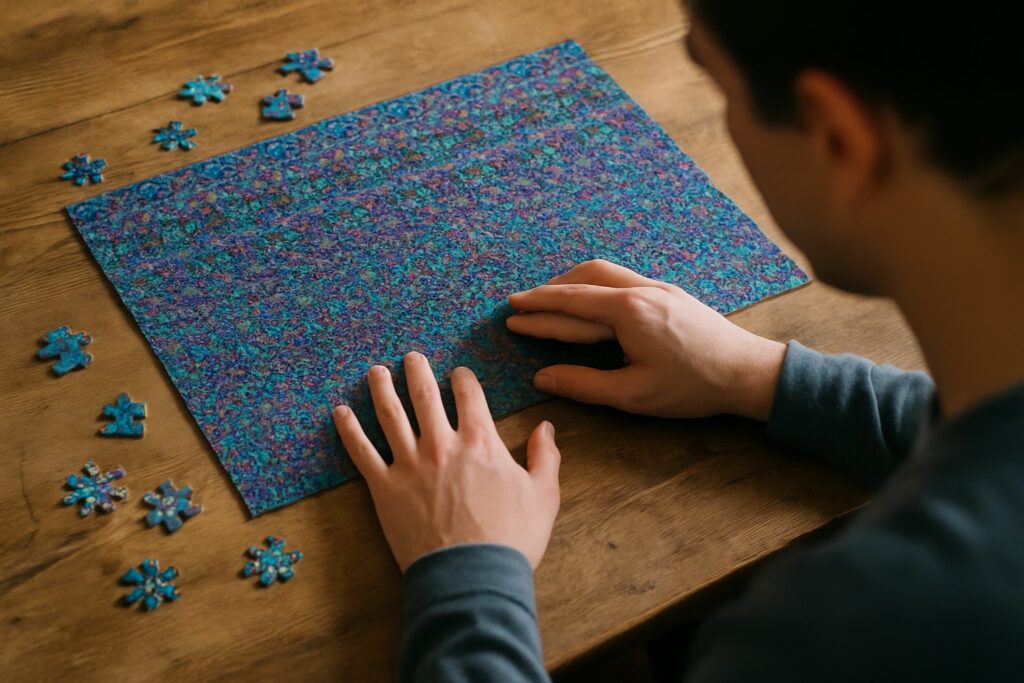
At first glance, the visual is disproving. Repeating, saturated, informed patterns, often in criar colours. We believe in a lack of impression or a graphic hallucination. Yet, somewhere in this chaos, a dolphin, a dragon, a galactic scene – but you will only see it if you know how to look.
The scientific origin of a visual phenomenon
The concept behind the Magic Eye is based on the the stereogramIn the 1950s, the Hungarian neuroscientist Béla Julesz develop the first randomly pointed stereogram. The objective: to test human binocular vision. He discovers that by generating two almost identical images, but slightly shifted, the human brain manages to extract a perception of depth.
Forty years later, the idea became a cultural phenomenon. In the 1990s, the American company Magic Eye Inc. popularizes the format with books with psychedelic covers, sold by millions. The craze is fulgurant. Magic Eye images invite on posters, calendars… and very quickly in the world of puzzle.
The marks are I’m not sure. and Ravensburger They’re launching the first official Magic Eye puzzles. Ceaco, more oriented to the general public, also offers some models. Success is based on a double challenge: assemble the image, then succeed in perceiving what it hides. This last point is fundamental — once the puzzle is finished, you have not seen anything yet. The test starts then.
See without looking: an eye mechanism
The real magic of Magic Eye is that they don’t need any accessories. No 3D glasses. No screen. No colored lens. Just your two eyes, a little patience, and a method of approach.
The most common technique is stick his nose against the imageAnd then you have to look at a fictitious point in the distance and then you have to slowly retreat, without making a point. three-dimensional object appears And it’s still there, stable, tangible, an effect that frustrates as much as it amazes.
Where a classic puzzle visually rewards you with every step, a Magic Eye rewards you with a new experience. Defy until the endYou can finish the 500 pieces and stand in front of a flat screen with no meaning, but when the illusion arises, the satisfaction goes beyond the pleasure of completing an image. perceptive victory.
The brands that dared to be deceived
Not all publishers have taken the risk of this particular exercise. MB Magic Eye puzzles, sold on a large scale in the 1990s, remain today the most emblematic. Massive boxes, deliberately aggressive images, solid pieces: they embody the aesthetics of their time.
Ravensburger, faithful to its qualitative DNA, tried some models, but quickly refocused its offer on more traditional visuals. CeacoHe is also known for his pop collaborations, and has released some intense colored Magic Eye, which are now sought after in the casual market.
Magic Eye Inc. It has also published a small series of puzzles, often in limited quantities, which are difficult to find new. These boxes have become collectible objects, some reaching more than €100 on eBay, especially in sealed version.
The rarity explains: 3D effect only works if the printing is perfectly calibratedA simple ink offset or poorly applied varnish can ruin the illusion. This makes their manufacturing expensive and risky, which explains their gradual disappearance from recent catalogues.
Experience in the margins of current trends
In today’s puzzle world, dominated by the return of the artistic designof minimalism and collaborations with independent illustrators, the Magic Eye is almost a Weird relicsTheir visual is not photogenic. They don’t lend themselves to wall exhibits or social media. They don’t flatter the eye, but they challenge it.
And yet their power remains intact. immediately differentAn image that you can’t consume at a glance, a puzzle that ends up blind, an illusion that only exists in your brain.
For puzzle lovers looking for a experience out of the wayThe Magic Eye is a must-see.struggle with his own perceptionAnd that’s a little puzzling.


Échanger autour de cet articleUne question ou une expérience à partager ?