The types of cutting
Each puzzle tells a story by how its pieces are cut. Cutout influences not only the visual style, but also the difficulty and strategy to adopt. From the classic grid to the most delusional forms, here are the different methods that spice up the assembly.
- Cut ribbon (cutting tapeThe pieces are a perfectly regular grid, which is easier to spot visually, and resembles an orderly grid.
- Other, including the following: : these puzzles break the codes with irregular, sometimes non-attachable, pieces to make the assembly more arduous. Imagine a puzzle where each piece is a small unique puzzle, impossible to assemble at random.
- Other, of a kind used for the manufacture of goods The pieces are cut according to the contours of an object visible on the image, like a hand-cut silhouette. This was the classic method of the first wooden puzzles, especially for cutting geographical maps.
- Cutting of the cut (cutting of the cut) : the standard industrial cutting since the 1930s. Imagine a huge metal piece cutter that cuts hundreds of identical puzzles into cardboard plates.
- Laser cutting The method is a modern method used for materials such as wood or acrylic, which cannot be cut with traditional presses.
- Half-cut These puzzles are not fully perforated, which allows them to be displayed in stores without the pieces falling.
Specific types and shapes of parts
Beyond the cutting, the pieces themselves have various shapes that make each puzzle special. Let’s discover the emblematic pieces and some surprises that spice up the assembly.
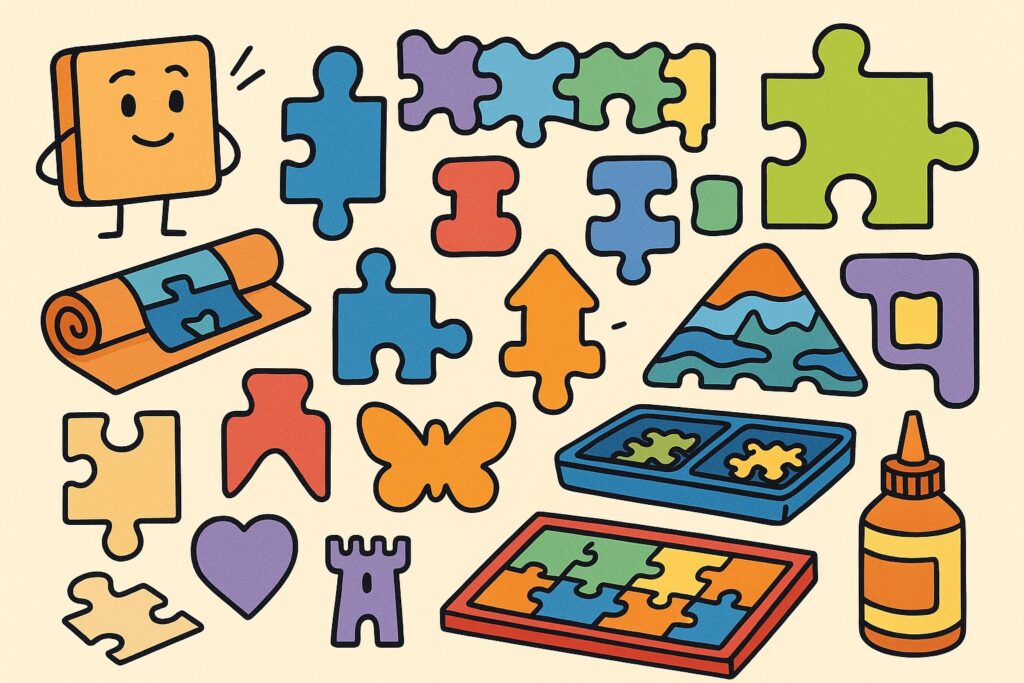
- Edge piece The first piece of the puzzle is the piece with at least one right side, which forms the edge and is often first assembled to delimit the frame.
- Corner piece (s) A special variant of the dashboard, with two straight sides, which mark the four corners and are the strategic markers of the puzzle.
- 2 x 2 / 2 tab / standard The standard pieces with two opposite ergots and two opposite hollow ones.
- Castle A charming term for a three-piece room, a kind of mini-fortress for assembly.
- Gemini A rare piece that can be placed both on the edge and inside, with two ergots in the middle and flat sides at the top and bottom.
- Whimsies These pieces are cut into the shape of objects (butterflies, hearts, cars), often made of wood, to add a playful and decorative touch.
Finishing and materials
The quality and texture of the puzzle play an important role in the game experience.This section explains the different types of finishes and materials you can encounter.
- Gloss finish : reflective surface which can interfere in direct light.
- Linen finish (matte finish / linen) : a slightly textured surface which limits reflections and makes the parts more pleasant to handle.
- FSC cardboard The following is a list of the environmental standards for this material: certified by the Forest Stewardship Council, this material is environmentally friendly.
- Half-cut (half-deep cut) The following are the puzzles cut without finishing, useful for presentations in stores.
- Fully interlocking (fully imitable) The parts hold together firmly, which allows the whole to be lifted up once finished (see challenges below).
The jargon of the puzzle
As with any hobby, the puzzle world has its own language, so get acquainted with these essential terms to talk easily between enthusiasts and understand the little peculiarities of puzzling.
- I’m not a puzzle nerd. The kind of person who prefers to spend a Saturday night assembling a 2,000-room, cloudy sky than watching Netflix.
- Dissctologist : a technical term for a puzzle enthusiast.
- The neck of a puzzler : well-known pain of the enthusiasts, caused by too long a posture leaning over the puzzle. A good chair or tiltable table can save your cervicals.
The challenges of puzzle players
Amateurs love to challenge themselves to see if their work is successful in the most demanding manipulation tests.
- Pick up challenge The following options are: to raise the completed puzzle without it disassembling.
- The Rotate Challenge The first thing to do is to turn the finished puzzle 360 degrees without it falling apart.
- The Puzzle Roll Challenge Aesthetic: the photo tunnel through the scroll.
The types of puzzles
Here are a few categories of puzzles that will put your patience and logic to the test.
- The classic puzzle The standard format with a printed image, cut into imitation pieces, ranging from 100 to over 40,000 pieces, often rectangular in shape.
- The wood puzzle / craft puzzle : more solid, often more beautiful, sometimes with original cuts or objects shaped pieces (the famous whimsiesA real touch and visual pleasure.
- The metal puzzle These puzzles require precision and dexterity.
- Plastic puzzle The following products are: solid, washable, durable. Pintoo They make high-quality versions of it, with precise embedding and sometimes 3D models.
- 3D puzzle Monuments, globes, models… they add an extra dimension (literally) to the challenge.
- The big puzzle : giant puzzles, sometimes with tens of thousands of pieces. Requires space, time… and determination.
- Puzzle gradient It may seem difficult, but some find the logical progression of colors soothing.
- Puzzle impossible : deliberately vicious puzzles: all white, without edges, multiple interchangeable pieces… Perfect to test its limits (and patience).
- The following is a list of the topics covered: A puzzle that contains the image of a puzzle or a scene with a puzzle.
- Shaped puzzle The following is a puzzle with the shape of the represented object (cat, world map, flower…).
- The Magic Eye Puzzle It’s an abstract-looking image that reveals a 3D scene if you look through it. Fascinating to the eye… and the brain.
- Puzzle to customize They can be ordered online and add a personal touch to the fun of the meeting.
The essential accessories
Putting together a puzzle requires organization and care, and some tools make life much easier for both the beginner and the confirmed puzzle player.
- Glue puzzle A special glue that allows a finished puzzle to be permanently fixed to make a permanent picture or memory.
- Puzzle mat / roll-up mat Carpets or rolls that allow you to store a puzzle in progress without dismantling it, perfect for time-consuming puzzles.
- Puzzle tray : a compartmented plate for sorting the parts by colour, shape or size, thus optimizing the time of search.
- Puzzle board : rigid tray, sometimes inclined, which serves as a stable surface to assemble the puzzle. Some models are rotating, others have a edge to prevent the pieces from falling. Very convenient if you miss space or want to move your puzzle from one piece to the next.
- Box support : small easel or base that keeps the puzzle box (or its visual) in a vertical position during assembly. No more neck pains by bending the head!
This glossary does not purport to cover everything, but it will already allow you to shine in your puzzle groups, to better choose your next challenges and above all, to enjoy every piece you pose with even more pleasure. The world of puzzle is vast, precise and passionate – a language alone.
Échanger autour de cet articleUne question ou une expérience à partager ?