
Choosing camp: gluing, disassembling or framing
It all starts with a simple question: what do we want to do with this puzzle ?
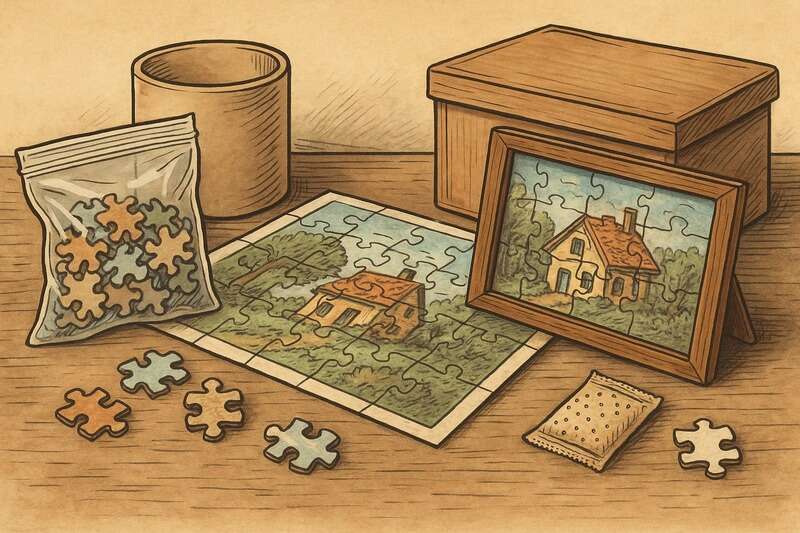
If the idea is to display it, hang it on a wall or turn it into a decorative object, sticking a puzzle becomes an essential step, often in the form of a glue-collar to be applied to the brush or roll. Contrary to popular belief, the glue does not penetrate deep into the rooms: it forms a film that attaches the whole to the surface. This allows the puzzle to be moved, dragged into a frame, or even stored vertically. But be careful not to use standard white glue, which can damage the colors or gland the cardboard.
For those who like to re-work their puzzles, or simply don’t have room to display a thousand pieces at a time, clean dismantling is another option. It takes care: no need to sweep everything in a box. The ideal way is to separate the parts into sections or blocks using sheets of sulphurised paper or fine cardboard and then stack them into a rigid box. A zip-locked bag or vacuum bag can also serve as a dampness barrier. This type of storage works better for cardboard puzzles, less for wood or metal, more susceptible to friction.
How to frame a puzzle is an almost museum gesture, especially if the puzzle in question is a work of art or a limited edition. There are puzzles-friendly frames, with a rigid back, glue-free holding system, and sometimes even an anti-UV glass. The frame protects the puzzle from dust, ambient humidity, temperature changes and, of course, clumsiness. It’s the queen’s solution to keep a wooden puzzle or a collection puzzle.
Consider the material: wood, cardboard, metal, 3D
A wooden puzzle doesn’t have the same whims as a cardboard puzzle. Wood is sensitive to fluctuations in humidity: it is too dry to crack; it is too wet to swell or deform. So you should avoid cellars, attics, rooms without ventilation or direct sunlight. If the puzzle is stuck, it must be with a transparent glue, without an aggressive solvent. And if the puzzle is disassembled, each piece should be protected, ideally in cloth bags or in a compartmented box covered in feather.
The cardboard is less noble but more tolerant, as long as water and prolonged pressure are avoided. A cardboard puzzle can be kept disassembled in its original box if it is rigid and well closed. To avoid room crashing, some use interlaced rooms, such as in archives. If it is glued, it is important not to use too much glue to risk gondola-riding. You can also add a rigid board to the back of the puzzle once it’s dry to stabilize it.
The metal puzzlesThe new technologies, often in 3D or relief, pose other challenges. They can’t stand moisture or friction. A thin layer of antioxidant oil applied with a soft cloth can prevent corrosion, as would be the case with collector’s items or tools. These puzzles should be stored mounted, if possible, dust-free, in a closed window or a double-decked foam trunk.
Finally, 3D puzzles (paper, plastic, foam) must remain assembled. To dismantle them is to risk damaging fragile parts designed for a single installation. So they are kept as models, sometimes under bells or in glass shelves.
Do Not Ignore Our Invisible Enemies
A puzzle does not need to live in a barren atmosphere, but some precautions prevent it from aging prematurely. Moisture is the main enemy: it can warp and soften the puzzle and sometimes cause mould. A simple bag of silica gel in the box or near the frame can make all the difference. Light, especially sunlight, discolors colors slowly, especially bright shades or pastel. Never place a puzzle attached or framed near a south-facing window.
The dust is getting everywhere. On a sticky, unframed puzzle, it settles in the interstities and tarnishes the image. A gentle brush stroke, such as those used for acrylic paint or makeup, is enough to make the household safe. Finally, insects (silver fish, whiting) can be attracted by the cellulose of the parts. An airtight box solves this problem at its root.
Keeping a puzzle is like keeping an old book or a rare wine: it all depends on what you want to do with it. Some will stick them as trophies, others will dismantle them to better find them later. But all of us need to understand our nature, our fragility, and take the right action so that we don’t see hours of patience turn to dust.
Échanger autour de cet articleUne question ou une expérience à partager ?