
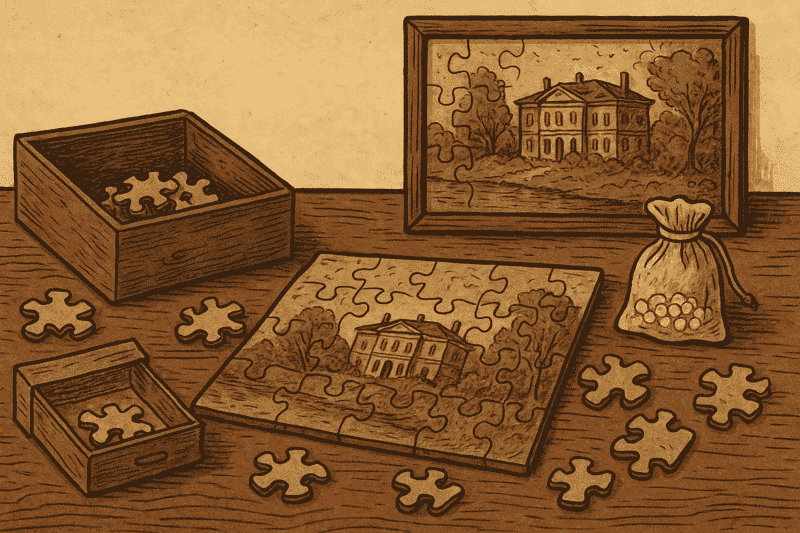
Understanding the Fragility of Ancient Puzzles
Ancient puzzles were not designed to go through a century. Solid wood cut by hand, raw cardboard sensitive to moisture, unstable inks, fragile varnishes… Each material reacts differently to time. wood puzzle For example, in the 1930s, it may have survived several generations of manipulations, but it may be broken down as soon as it is stored in a room too humid. It is exactly like an old comic book: direct light, a fold, too high humidity, and degradation begins.
Keeping an old puzzle therefore amounts to protecting three key elements: the parts themselves, the printed visual (often glued to the pieces or to a cardboard holder), and the original box, when it is present. The last point is crucial: a vintage box, even if damaged, adds value to the object, as does an original packaging for a vintage figure.
Storage: between museum and shoebox
The worst enemy of an ancient puzzle is the environment. High humidity causes the cardboard to gondola, the corners to melt and the printed visuals to take off. Conversely, too dry air can cause wood to break, especially on saw-cut puzzles. The ideal place is a dry, temperate place and sheltered from direct light. Think of a wine cellar (without alcohol), or better, an airtight storage box with silica gel bags inside. The latter absorbs ambient moisture and protects sensitive materials. Type boxes ⁇ Tupperware ⁇ or archive sorting boxes are ideal.
You never have to pile up old puzzles anyway. The weight can flatten corners, create tension in the boxes, or even cause some pieces to stick together, especially if they have been exposed to heat. Place them flat, piece by piece, in individual boxes if possible, or separate them by using sulphurised paper or silk sheets.
What do you do with a puzzle?
Many enthusiasts put together their old puzzle once to expose it. If that’s the case, don’t stick the puzzle directly, especially if it’s old. Unlike modern puzzles which can be glued with specific water-based glue, vintage puzzles do not respond well to contemporary products. Glue can damage inks, cross materials, or gondola them. Instead, use a reversible method: you can place your puzzle mounted on a thin board, cover it with a transparent film (mylar type) and hold it with a pressure-free frame. This allows it to be exposed without altering its structure.
If you really want to fix it, then use taped archiving on the back or a glass frame with a universal glass, avoiding any direct contact with the glass. And always keep a photo trace of the puzzle before framing, with the box if possible.
Restoration or not
You got any used parts, damaged corners, tainted visuals? The desire to restore is normal, but beware: restoring a vintage puzzle is like touching a painting. You can ruin everything by thinking you’re doing the right thing. Painting pieces by hand? That’s a bad idea, unless you’re familiar with the pigments and the printing style of the day. – You want to stick the broken corners ? Possible, but only with neutral glue, solvent-free, type of glue.
In doubt, it is better to stabilize the current state of the puzzle than to try a home restoration. As with an ancient book, the most important thing is to stop the degradation without erasing the traces of time. A vintage puzzle has the right to have lived.
An old puzzle, you can share it?
Yeah, but not anyways. If you want to lend or pass on a vintage puzzle, you have to document it. Create a sheet with the photo of the puzzle, the approximate date, the mark, the number of pieces, the origin. Add a photo of the box, note any missing parts, and specify recommended storage conditions. It’s not snobbery, it’s transmission. You wouldn’t think of lending a vinyl collector without its cover and booklet.
Échanger autour de cet articleUne question ou une expérience à partager ?