

Cardboard, a whimsical material
The cardboard used to make puzzles is composed of several pressed layers: a base of compacted fibres, a printed layer glued on it, sometimes a thin layer of varnish to protect the whole. This sandwich, as stable as it may seem, is extremely sensitive to humidity, heat, and repeated handling. The slightest excess of water causes the printed layer to gondola or detach. Excess heat, such as radiator or sunlight, can cause corners to curve or cause ink cracks.
You want to avoid that? Start by never storing a puzzle in a room where you wouldn’t leave a book: bathroom, kitchen, uninsulated attic, wet basement, that’s no. The ideal temperature is between 15 and 22 °C, with a humidity rate of less than 60%. This may sound pointy, but in practice a living room with a constant temperature does very well.
Before and after assembly: two different strategies
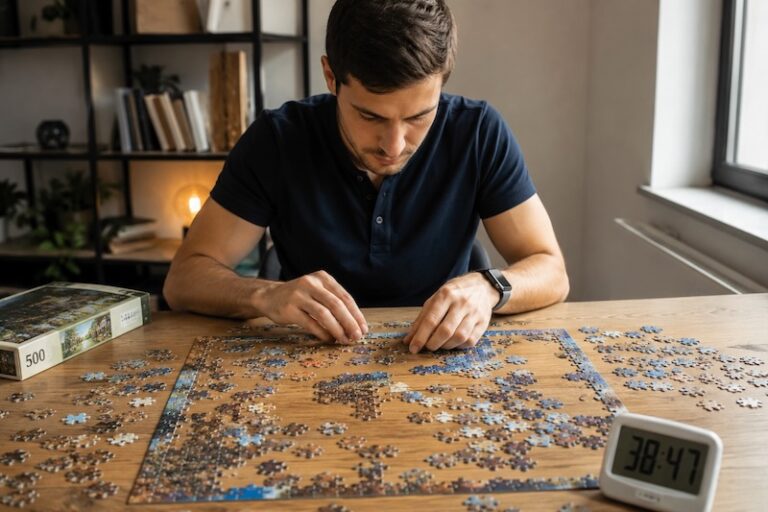
A new puzzle, still in its box, is kept very well… provided you don’t open the bag of pieces and store the flat box. Once the puzzle is opened, it becomes vulnerable. The use starts with the first handling. Therefore, it is useful to sort the pieces carefully, not to let them drag anywhere, and to avoid rough or dirty surfaces. The cardboard parts absorb fat, dust and liquids easily. A cup of coffee turned upside down, and it’s irrecoverable.
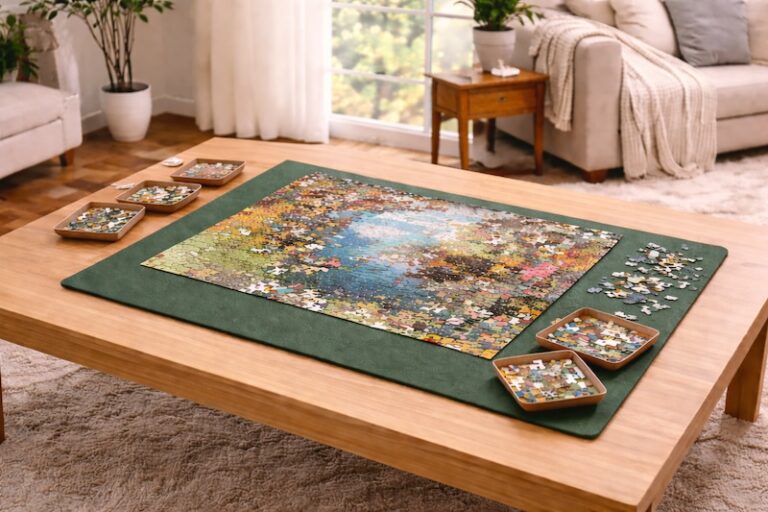
If you’ve put together your puzzle and you want to keep it together, you have two options. You may want to be able to disassemble it later: in this case, use sorting trays, sheets of feather or a rigid board to move or store it. You want to keep it as it is to expose it, then you’re gonna have to stick it.
Glue a puzzle into cardboard without ruining it
Getting a puzzle Cardboard has become almost a rite. But too often, people use the wrong glue or apply the glue anyway. The result: gondola pieces, white traces, dull colors. To avoid this, use a special water-based puzzle glue designed to be spread directly over the visual. The best glue dries clear without altering the colors.
Tip: apply the glue with a flat, thin, regular layer, stretching well to the edges. Let it dry for several hours. And most importantly, don’t raise the puzzle until it’s dry: it could crack. Once dry, you can strengthen the whole by gluing a thin cardboard to the back or using a stiff pen-cardboard support.
If you want to frame, make sure you choose a suitable frame: neither too tight (risk of pressure on the parts), nor too loose (risk of movement).Use a passout or holds to stabilize the puzzle in its frame.
The box: never neglect it
You really want to keep your puzzle in good shape? Don’t neglect the original box. It protects the pieces, it contains the visual, and it allows you to quickly find the puzzle in question. Don’t over-handle it, don’t stick anything on it, don’t leave it in a sunny place. If you want to go further, put each puzzle in a zipped plastic bag, with the printed visual and the number of pieces marked inside. Serious collectors even photograph the finished puzzle, with the box, to get a digital trace.
Another point: never stack too many boxes on each other. Weight can crush those on the bottom, damage corners, or twist the thin boxes. A dedicated shelf is ideal. Otherwise, store them flat, with the heaviest puzzles at the bottom.
In case of damaged puzzle
A cardboard puzzle that has taken the moisture is rarely recoverable. You can try squeezing it between two absorbent sheets with a weight on it for 48 hours, but the result will be random. If a piece is torn, use a white, acid-free glue to repair it. But avoid bright scotch or strong glue that leaves traces or makes the surfaces shine.
Échanger autour de cet articleUne question ou une expérience à partager ?