
A living thing that reacts
The wood lives, moves, expands, contracts. Humidity is his worst enemy. Too much moisture, and the parts swell, stick together, stick together badly, or worse: they glow. Too dry, and the pieces can crack. The best way to do this is to store the puzzle in a temperate place, between 18 and 22 degrees Celsius, with a stable hygrometry. Avoid cellars, attics, sunny windows, or rooms that are not heated. An indoor closet or a closed library is perfect. No need for a safe, but no fireplace edge either.
We also forget about the plastic bags that keep the wood from breathing. Preferably a rigid box, made of thick cardboard or wood itself, if possible covered with silk paper or fine cloth. The objective is twofold: avoid friction between parts, and maintain a gentle atmosphere. An untreated cotton cloth, old-fashioned torch, does the job very well. Forget about the paper: it can leave ink traces and react with varnishes.
Manipulating without damaging
You can never say it enough: wooden puzzles are not meant to be played. Each piece is often cut by hand or laser, with a precision that is not to be envyed by the markers. If you’re putting together your puzzle, use a smooth, rigid, clean surface. A fine wood or MDF board is an ideal support. We avoid carpets in the loft: they hang the edges of the pieces.
When you remove it, do not throw it in bulk in its box. Sort it by section if possible, or pack it piece by piece. The antique or collection puzzles sometimes deserve that each large piece be packed in silk paper, like a porcelain figure.
If you want to leave the puzzle mounted, for example to expose it, you can paste it. But be careful, not just anyways. Classic glue is often too wet or too aggressive. Preferably a special puzzle glue or a neutral, solvent-free PVA glue, which you will apply with a soft brush. Always test in a discreet corner if the wood is raw. Some high-end puzzles, painted or hand-painted, don’t like to be stuck at all.
Protecting the Motifs and Finishings
Many wooden puzzles are painted, painted, sometimes embedded. These finishes require special care. Avoid cleaning products. No towel, no wet cloth, let alone spray. If a room is dusty, blow it gently or use a very soft hair brush, such as a clean makeup brush.
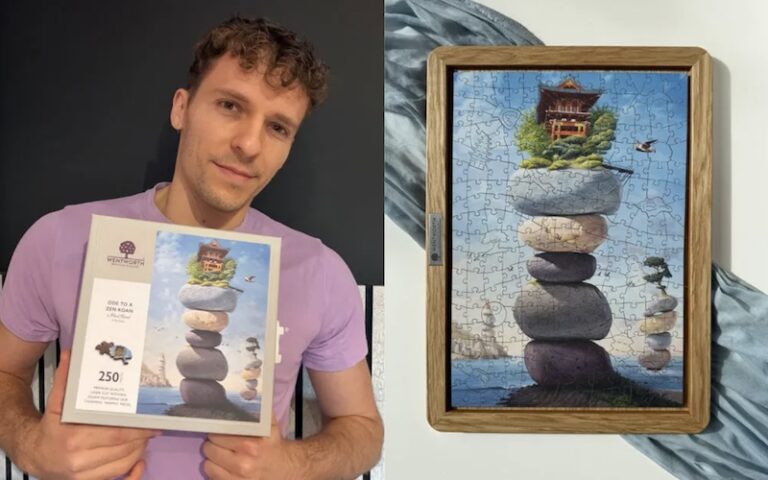
A good example: the Liberty puzzles or Wentworth Puzzles, often decorated with natural inks and complex cuts. Too strong pressure, or too tight storage, can break the ends of the 的whimsies, these pieces with fancy shapes. Better to store them flat, and even to separate them with fine paper interlayers.
If your wooden puzzle is very old—typically early 20th or earlier—the risk also comes from the old wax or unstable varnish finishes. In this case, avoid the glue, moisture, and even the LED lamps too powerful. The best is to keep your wooden puzzle in the same way. keeping the puzzle The Commission has also adopted a proposal for a directive on the protection of the environment.
What if we want to frame it?
Framing a wooden puzzle takes a little more care than a cardboard puzzle. The weight is higher, the parts may be slightly uneven. Luxury option: a floating frame, with the puzzle glued to a rigid board, and a wrap around to avoid friction. The glass, on the other hand, should be UV-resistant and slightly spaced. The glass is not pressed directly on the parts, otherwise the wood can become thick or deformed.
For a very graphic or decorative puzzle, this kind of framework makes the object a work of art. Puzzles by Michèle Wilson Or craft that we don’t want to dismantle.
Last word on the transmission
A wooden puzzle is often a legacy. When it is complete, well preserved, and still in good condition, it is valuable. Not only in euros, although some are very expensive, but in memory, culture, history. A well-preserved wooden puzzle is like an ancient book: a tangible witness that can be passed on. If you have a puzzle you really like, take care of it like an old piece of furniture or a rare vinyl record. Because one day, he’ll tell your story, piece by piece.

Échanger autour de cet articleUne question ou une expérience à partager ?