
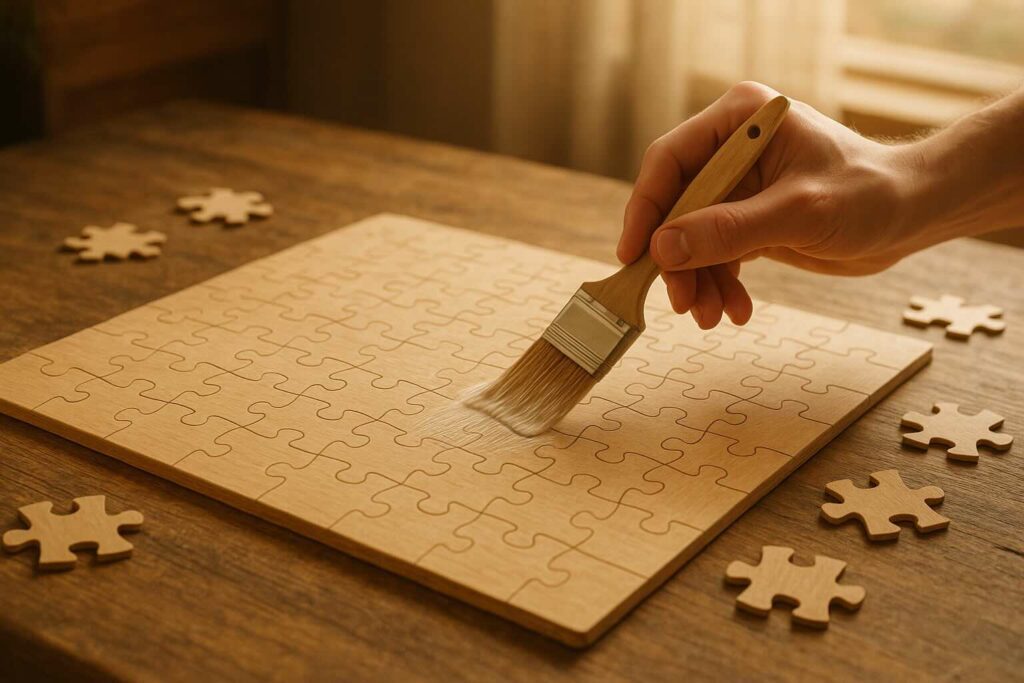
Preparing the stage as a conductor
Imagine you’re preparing a show: every element must be in its place, ready to play its part. Same thing here. Before any manipulation, the puzzle must be completed in its entirety. Of course you do. But also clean: no crumbs, no dust, no greasy fingers. A dry brush or air bomb can do the trick to dust off the grooves. Then, you gently slip sulfurized paper or wax paper under the puzzle. The enemy here is the glue that’s shaking. The newspaper must be banned: ink must be removed, paper must be scraped.
Your work surface must be flat, rigid, ideally protected. If you work on a fragile table, put a plastic sheet or cutting board underneath. At this point, nothing should be able to compromise the rest.
What glue do you use for a wooden puzzle?
Forget about the school glue. We’re talking about technical glue.
- The puzzle stick It is designed specifically for this type of work. It penetrates the interstice, becomes transparent by drying, and offers good support. It works well with medium density wood puzzles (MDF, plywood).
- White wood glue (vinylic) This is the one used in carpentry. It is perfect if you intend to fix the puzzle on a board. However, be careful about the thickness of the application: it can gondola slightly if you put too much.
- Spray glue The first step is to avoid complicated or expensive puzzles.
Hybrid glue (textile or paper glue) is also available, but is rarely needed except in special cases (very fine pieces, handmade puzzles).
Application: no rush
There are two great schools. On the back Then you can fix it on a support. the rectum, glass-making.
In the case of a wooden puzzle, the reverse method remains the ideal.
Once the puzzle is flat on your wax paper, place another rigid board over it and roll it together like a pie. Remove the paper, and you’ve got the back of the puzzle in front of you. At that time, two options: either apply the glue directly to the back of the puzzle using a flat brush (crossing the passes to cover all the joints well), or apply the glue to the support (wood, featherboard, etc.) and you put the puzzle on it.
Some prefer to apply glue to the puzzle to ensure that each piece is fixed, others to the support to avoid confusion.
A roll of marouflage or a plastic spatula then allows to plate the pieces well. Presses without forcing. We remove the air. We check the edges. We clean the overflows with a damp cloth. Then we place a uniform weight (books, other board) on the whole for 24 hours.
What happened after that?
Once dry, your puzzle is ready to live a second life. You can fix it in a frame, hang it on the wall, or you can put it like it is. For purists, a layer of varnish can sublimate the whole. Choose a matte or satin acrylic varnish, colorless. Apply it with a wide brush, in a thin layer. Wait until the puzzle is completely dry before you jump.
Some enthusiasts go so far as to seal the puzzle with an epoxy resin. Bluffing result, painting effect, but it’s another league, and this requires perfect control of mixtures, timing, and air bubbles. To avoid on a first try.
Paste a wooden puzzleThe concept of a work is therefore much more than a technical operation: it is an aesthetic choice, a desire to retain a work, an emotion. cardboard puzzles often thrown or disassembled after use, those made of wood deserve to be exposed. Their weight, texture, even their smell evoke a craft that it would be a shame to leave in a box.
And for those who ask themselves: no, it’s not irreversible. If you use non-permanent glue (some puzzle glues are designed for), you can one day untie the pieces. But at that time, the real question will be: why disassemble what you took so long to build?
Échanger autour de cet articleUne question ou une expérience à partager ?