
In a daily life marked by screens, notifications, work, mental noise and permanent feeling of going too fast, the puzzle offers a different space. It invites to slow down, to focus on a concrete task, to use its hands, its look and its attention in a more laid way.
The puzzle is not a magic solution to stress or mental fatigue, but it can become a real wellness tool: simple, accessible, creative and deeply satisfying.
A busy break in a world that is too fast
We live in an environment where everything goes fast. Messages arrive continuously, content chain, days are often fragmented by screens and solicitations. Even moments of rest can be filled with videos, social networks or new information to absorb.
The puzzle offers another form of pause.
It’s not a passive pause, like scrolling a screen without really thinking about it. The brain remains active, but it works at a different pace. You see the colors, shapes, details. You sort, compare, try, adjust.
This activity requires attention, but it is not urgent.
It is precisely this mixture that makes the puzzle interesting for well-being: it creates a cut, while giving something concrete to do.
A focus without pressure
One of the great strengths of the puzzle is that it promotes concentration without necessarily creating pressure.
There is no need to be performing. There is no need to finish fast. There is no need to succeed perfectly from the first stroke. One can simply move, piece after piece, at its own pace.
Of course, there is also speed puzzle, with times, personal records and competitions. But in a quieter practice, the puzzle can become a space where the goal is not to go fast, but to be present.
The eye is on the details.
Hands are handling the pieces.
The mind seeks connections.
The image appears gradually.
Gradually, one enters a form of bubble. The puzzle occupies enough attention to remove the parasitic thoughts, but without requiring mental tension of an urgent or professional task.
The joy of seeing an image take shape
Much of the fun of the puzzle comes from its visible progression.
Initially, there is only one box, one image, and a bunch of mixed pieces. Then some details connect. A color is specified. An area appears. A face, a landscape, a texture or a pattern begins to take shape.
This transformation is profoundly satisfying.
Unlike many digital activities, the puzzle does not give an immediate reward. It takes time. You have to accept uncertainty, mistakes, blocking moments. But every little advance becomes a victory.
This gradual pace can help to reinvent patience, and it reminds us that not everything needs to be instantaneous to be pleasant.
A moment away from the screen
For many people, the puzzle is also becoming a simple way to reduce screen time.
Assembling a puzzle requires visual attention, but in a way very different from that of the screens. You do not receive continuous information. You do not respond to notifications. You do not skip from one content to another.
We’re only on one activity.
This simplicity can do a lot of good, especially after a day spent in front of a computer or a phone.
It’s an ideal activity for a calmer evening, a slow Sunday, a break after work or a break before bedtime.
A gentle training for the mind
Even when practiced for relaxation, the puzzle remains a real mental exercise.
Putting together a puzzle involves a number of skills:
- The following is a summary of the results:
- the visual memory;
- the logic;
- Patience;
- the perception of space;
- recognition of colours and patterns;
- The ability to change strategy.
Every puzzle requires to make small decisions continuously. Where to start? Should we sort by color, form or detail? Which area seems the easiest? When should we insist? When is it better to move on?
These are simple micro-decisions, but they keep the mind engaged.
The puzzle can therefore be seen as a form of gentle mental training: stimulating, but not aggressive; demanding, but soothing.
The Puzzle as a Patience Tool
One of the most interesting aspects of the puzzle is that it forces you to accept the process.
Some pieces are found quickly. Others resist. An area that seemed easy can become more complicated than expected. A detail that has been sought for a long time sometimes ends up appearing at the moment when it stops forcing.
The puzzle is learning to slow down.
He calls for more observation, tolerance of uncertainty, to stay with difficulty without seeking an immediate solution. This patience is one of the reasons why many people find this soothing activity.
We can’t control everything.
We can’t solve this right away.
But we’re still moving forward.
Slow puzzling or speed puzzling: two ways to live the puzzle
There’s no one good way to do a puzzle.
Some people like it. slow puzzling They take their time, choose a calming image, move ahead timelessly, enjoy the environment and the process.
Others prefer the speed puzzling They can also be: start a timer, improve their time, test strategies, participate in contests or compare their performance.
These two approaches may seem opposite, but they complement each other very well.
Slow puzzling is about calmness, presence and disconnect.
Speed puzzling is a game of strategy, progress and personal challenge.
Depending on the day, you may need one or the other, and the puzzle can be a moment of rest, a mental training, a challenge or a social activity.
It’s this flexibility that makes him so rich.
How to integrate puzzles into a wellness routine
It is not necessary to do long sessions to enjoy the benefits of the puzzle.
Here are some simple ideas:
- Do 15 to 20 minutes of puzzle after work;
- replace part of the evening screen time with a puzzle session;
- Keep a puzzle running on a table;
- Choose a little puzzle for busy days;
- Do a quiet puzzle after a sports session;
- puzzling with soft or silent music;
- I don’t always schedule my sessions.
The objective is not to add a new obligation to your daily life.
Choosing the right puzzle to relax
Not all puzzles provide the same experience.
For a relaxing session, it is often better to choose an image that makes you want to spend time with it: a landscape, a warm illustration, a colorful scene, a work of art or a visual with pleasant areas to explore.
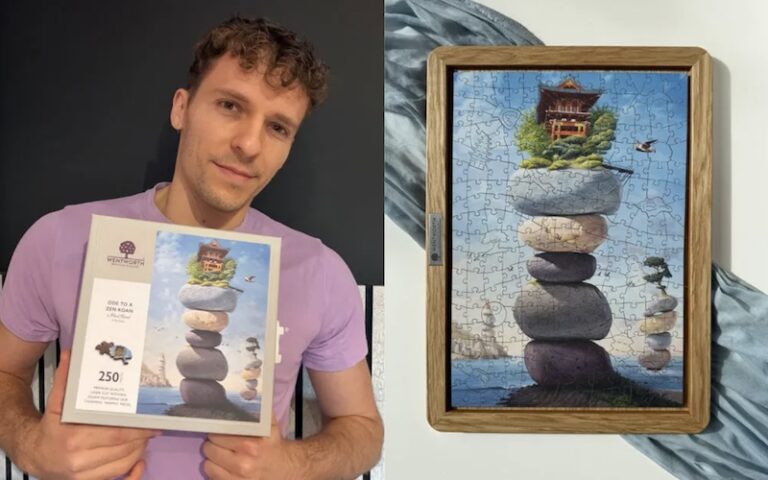
Wooden puzzles can also offer a particularly sensory experience. The pieces are thicker, sometimes irregular cuts, more surprising shapes. This often encourages a slower and more attentive practice.
Conversely, a very difficult, very dark or very repetitive puzzle can be satisfactory, but it may not be the best choice if the main objective is to relax.
So the right puzzle depends on the moment: sometimes you want a challenge, sometimes you just want a quiet moment.
The Commission
Puzzles are much more than a hobby, they can become a real break in a fast, connected and often demanding everyday life.
They offer a concentration without pressure, an activity away from screens, a gentle training for the mind and a concrete way to slow down. They allow to move piece after piece, without emergency, while finding the simple pleasure of seeing something take shape.
The puzzle doesn’t replace rest, sports or other forms of well-being, but it can complement them.
And perhaps that is its greatest strength: it creates a space where you can be both active and calm, focused and relaxed, busy and calm.
Échanger autour de cet articleUne question ou une expérience à partager ?