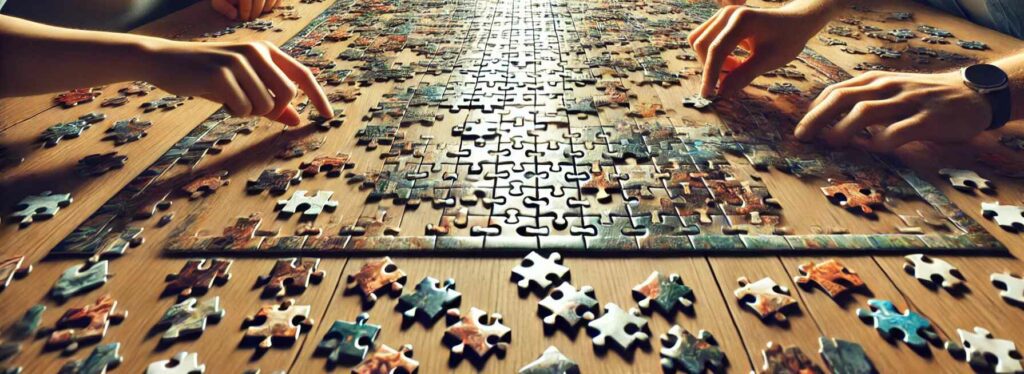
In a few years, the speed puzzle has moved from a challenge between enthusiasts to a structured competitive scene. Today, there are local competitions, national championships, online events, continental championships, etc. l’European Jigsaw Puzzle Championship, world competitions such as the World Jigsaw Puzzle Championship, and new international formats such as the The Speed Puzzle World Series.
In this article, we take stock of what a speed puzzle contest is, how it works, what the big events to follow, how to register, and why to participate even when you start.
The speed puzzle
Historically, the puzzle is rather associated with a calm, slow and contemplative activity. You take your time, you sort the pieces, you assemble the image gradually, often without looking at the clock.
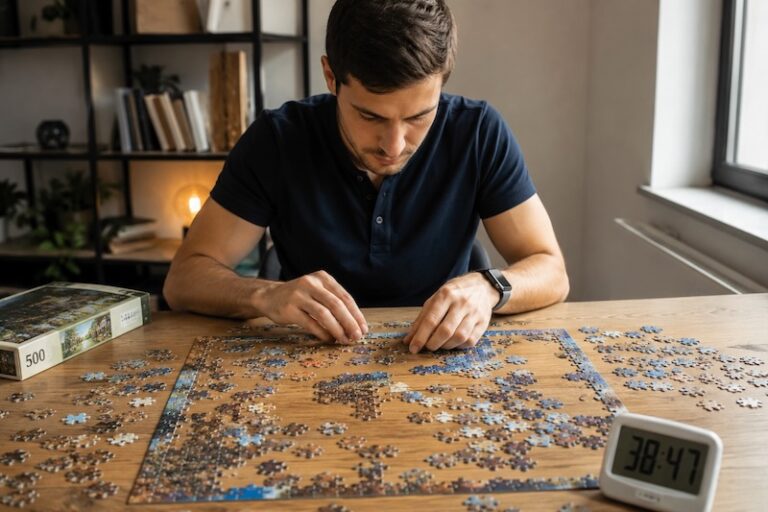
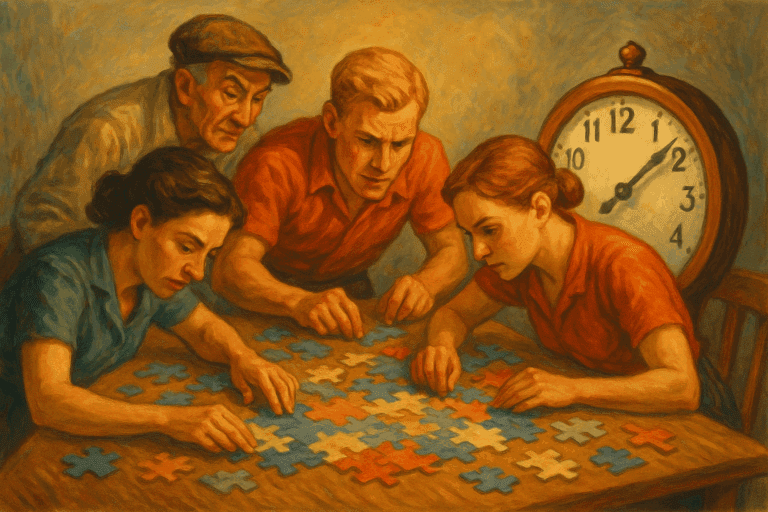
The speed puzzle completely changes this approach. Here, the time becomes central. The goal is no longer just to finish the puzzle, but to finish it as soon as possible, alone, in a duo or in a team.
This development was driven by several factors:
- the growth of puzzle-makers’ communities on social networks;
- the popularity of personal timepieces at home;
- online competitions;
- national and international championships;
- The increase in visibility of events such as the WJPC, the EJPC and the SPWS.
The World Jigsaw Puzzle Championship Today is one of the world’s top events in the field. The 2026 edition, organized in Valladolid, offers in particular individual categories, pairs and teams, with puzzles of 500 to 1000 pieces in different formats.
In addition to the World Cup, the The Speed Puzzle World Series The competition was presented as an elite international competition, with a first edition in Munich on 1 and 2 May 2026, built around 6 challenges and a cumulative time ranking.
How does a speed puzzle competition work?
The rules vary according to the events, but the principle is generally the same: each participant receives a sealed puzzle, discovers the image at the time of departure, and then has to assemble as soon as possible.
In most competitions, the puzzle is the same for all participants in the same round.
The competition can be held in several formats:
- Individual : one person assembles the puzzle alone;
- pair / pair Two people working together;
- team : often 3 or 4 people according to the rules of the event;
- online : participants perform the puzzle at home, sometimes live or with video proof;
- in the face The participants are all in one room, with a common departure.
The puzzles used are often 500 pieces For individual events, this format allows you to have a real challenge while remaining compatible with reasonable competition times. Duo and team formats sometimes use larger puzzles, including 1000 pieces.
The most common rules
Although each organiser can adapt its rules, there are often common rules.
The puzzle must remain closed until the start signal. Participants cannot start sorting the pieces before the time. The final time is recorded when the puzzle is finished, usually when the participant raises his hand or clearly signals the end.
Competitions may also include:
- penalties for missing parts;
- maximum time per test;
- a classification of unfinished puzzles;
- rules on external aid;
- instructions for silence or calm during the handles;
- specific rules for minors or age groups.
In the big championships, puzzles are often chosen not to be known in advance. This prevents a competitor from training on the same model before the event.
The main types of speed puzzle competitions
Not all speed puzzle competitions are the same. Some are very accessible, others are much more demanding.
Local competitions
These are often the simplest events to start with. They can be organized by an association, a library, a puzzle shop, a club or a festival.
The atmosphere is generally friendly, with short formats and easy to understand rules.
National championships
More and more countries are organising their own national competitions, which bring together the best puzzle players in a country and also introduce the discipline to a wider audience.
They can offer several categories: individual, duo, team, junior, senior or beginner as appropriate.
Continental competitions
L’European Jigsaw Puzzle Championship, often abbreviated EJPC, represents the European speed puzzle scene. An independent European structure, the European Committee for Jigsaw Puzzleling, was created to coordinate and represent European competitive puzzle associations.
The EJPC enables European puzzle players to measure themselves in a wider context than a national championship, while creating a common meeting place for the communities of different countries.
The World Championships
The World Jigsaw Puzzle Championshipor WJPCThe World Championship of Speed Puzzles is one of the most visible and followed events in the sport.
It usually offers several competition formats: individual, pairs and teams. For the 2026 edition, the official website announces for example individual events on 500 pieces, pairs on 500 pieces and 1000 pieces, and team events on 2000 pieces.
It is now a benchmark for competitors who want to compete at the highest international level.
The new international formats
The The Speed Puzzle World Seriesor SPWSInstead of focusing on a single round or a single type of puzzle, the format emphasizes versatility.
The first edition, held in Munich in 2026, offered 6 different challenges over two days, with a final ranking based on cumulative time. The concept therefore aims to identify the most regular competitor on several styles of puzzles and formats.
Competitions in person: a real challenge physically and mentally
Competitions in person are a very different experience than a home choreography.
In a competition room, everything changes: noise, the presence of other participants, the public’s gaze, the common departure, the organisation’s announcements, the management of the table, and sometimes even the pressure to see someone finish before you.
A competitive competition therefore tests several skills at once:
- the speed of assembly;
- the ability to remain focused;
- stress management;
- the organisation of the space;
- mental endurance;
- The ability to stay out of the way.
It is also one of the great pleasures of speed puzzle: meeting other enthusiasts, exchanging strategies, discovering puzzles, comparing methods and experiencing a competitive atmosphere rarely present when one’s only home puzzle.
Online competitions: a world stage accessible from home
Online competitions have played an important role in the development of the speed puzzle, allowing participants from several countries to compete without moving.
Events such as The Euro Jigsaw Jam Virtual competitions are offered in different formats: solo, in pairs, 500 to 1000 pieces puzzles, live or more quiet competitions depending on the objectives of the participants.
The main advantage is accessibility. It is often enough to order or receive the puzzle, to comply with the rules of the event, and then submit its time according to the method requested.
Online competitions are particularly interesting for:
- to discover the competition without travelling;
- Compare your time with other puzzle players;
- training in official formats;
- to join an international community;
- progress at his own pace.
Depending on the event, video evidence or live participation may be requested to validate the time.
How do you prepare for a speed puzzle competition?
Participation in a competition does not necessarily require being an expert, but a little preparation can make a huge difference.
The first thing to work on is the method. Many beginners think that it is enough to go fast with their hands, while the most important thing is often to waste less time.
Some useful training areas:
- learn to sort quickly;
- recognise large areas of colour;
- use the box image effectively;
- not remain trapped in an area for too long;
- work the edges without spending too much time;
- improve reading of the shapes of the pieces;
- training with a schedule;
- Re-work some puzzles to improve his method.
For further information, please see our guides:
- Starting the speed puzzle
- Speed puzzle: tips to blow up your records
- 12 months training plan to progress in speed puzzling
These resources are particularly useful if you want to move from a simple time at home to a real competition.
Do you have to be very fast to participate?
No, it’s a common idea.
You don’t have to be on the world’s top to compete in a speed puzzle competition. Many events host puzzle players of very different levels. Some come to aim for a podium, others to break their personal records, discover the atmosphere or just have a good time with the community.
The important thing is to know the rules, respect the other participants and accept that time is part of the game.
For a first participation, the objective can be very simple:
- complete the puzzle within the time allocated;
- Stay calm during the test;
- better to organize your table;
- discover its real level;
- I’m going to meet other passionate people.
Competition can be serious without being intimidating.
Why do you want to compete in a speed puzzle competition?
A speed puzzle competition offers much more than just a ranking.
It is first a very motivating experience. The timing gives a clear objective, and each session allows to measure its progress. Even without aiming for victory, it is very satisfying to see its time improve.
It is also a great way to develop certain skills:
- concentration;
- visual memory;
- Logic;
- spatial perception;
- stress management;
- the decision-making process.
But one of the greatest interests remains the community. Contests allow you to meet people who share the same passion, exchange tips, discover brands of puzzles and track the performances of the best puzzlers.
For many participants, the event becomes both a social moment and a personal challenge.
Where can I find speed puzzle competitions?
To find a competition, the easiest way is to follow several sources:
- official championship sites such as the WJPC;
- the pages dedicated to European competitions such as the EJPC;
- online competition platforms such as Euro Jigsaw Jam;
- the pages of national federations or associations;
- Facebook groups and speed puzzling communities;
- the specialist shops;
- I’m also a big fan of the specialised blogs like The Puzzle Fit.
On The Puzzle Fit, we regularly follow the major speed puzzle competitions, including:
- The World Jigsaw Puzzle Championship
- l’European Jigsaw Puzzle Championship
- The The Speed Puzzle World Series
- puzzles used at big events
- results and formats of the competition
The Commission
The speed puzzle competitions show how dynamic, strategic and international the puzzle can become. Whether online, in a small local competition, at a national championship, at the WJPC, at the EJPC or in a more recent format like the SPWS, each event offers a different way of living its passion.
To participate in a contest is not only to seek to be the fastest. It is to learn to better puzzle, manage your stress, discover new strategies, meet a community and set a concrete goal.
Whether you’re a beginner or an experienced competitor, speed puzzleting now offers more and more opportunities to start. And sometimes the hardest part is not to finish the puzzle: it’s just to get into the first contest.
Échanger autour de cet articleUne question ou une expérience à partager ?