The cardboard, the puzzle king material
The paperboard has been the king of the puzzle for decades, because of its perfect balance between cost, strength and quality of assembly. wood puzzles, which offer different rigidity and touch, or plastic puzzles, often reserved for children’s games, the cardboard allows to have a very fine and detailed print surface, which is crucial to reproduce complex images such as paintings, photos or very precise patterns. For example, imagine a 1,000-piece puzzle that depicts a Monet landscape. The colour and shade rendering will depend heavily on the quality of the cardboard and its processing.
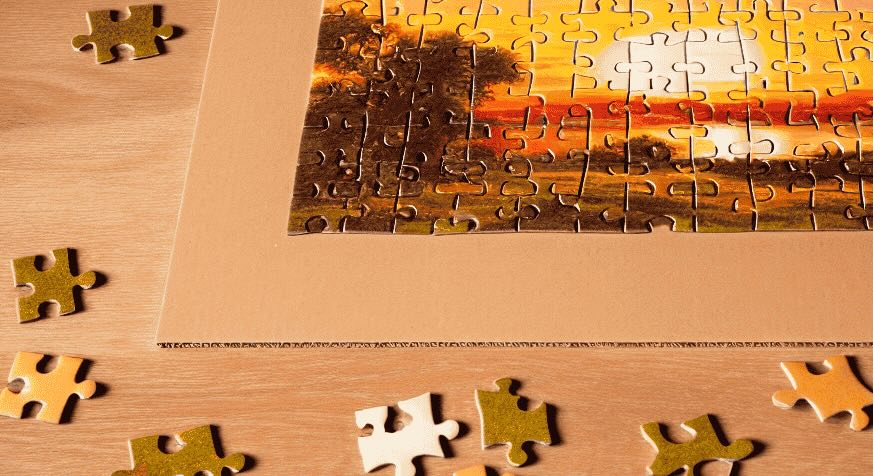
The cardboard used for puzzles is usually a rigid cardboard, often made up of several layers glued together, a bit like a sandwich. This structure gives it good strength while remaining light enough to handle the parts effortlessly. A puzzle piece must absolutely keep its shape and not break or deform when it is handled or placed. This is where the quality of the cardboard comes into play: too thin or poorly treated cardboard can make the experience frustrating, with fragile pieces that tear easily, while too thick cardboard could harm the precise fit of the pieces.
Printing and cutting – Key Steps
Printing is another key step. The cardboard puzzle is first a medium for an image. The printing process is often offset printing on paper, which is then pasted onto the cardboard. This technique ensures a very good color fidelity and a good definition, but it also implies that the paper must be well glued and protected to avoid the image getting worse over time. Some manufacturers use mats or glossy varnishes to protect the surface, which also affects visual and tactile comfort. A matte varnish can reduce the disruptive reflections, while a bright varnish gives more depth to the colors.
The final step is to cut the pieces, which will make all the difference in the quality of the puzzle. A very precise laser or mechanical cutting tool allows for the creation of parts with varying shapes and perfectly matched. Each manufacturer has its “signature” in the cutting style: some brands prefer classic parts, others opt for very original cuts, with asymmetrical shapes or personalized parts (animal shapes, letters, etc.). This variety creates specific challenges for each puzzle and makes the experience unique. The proper arrangement of the pieces is crucial to prevent the puzzle from unraveling once assembled, or having unpleasant spaces that spoil the rendering.
The cardboard puzzle can be compared to a piece of art to be assembled, where each piece is a small area of the overall image. The complexity and satisfaction of completing a puzzle depends as much on the quality of the material as on the cleverness of the cutting and the fineness of the printing. The cardboard is therefore both a functional and aesthetic material.
Sustainability, maintenance and environmental impact
A question often asked is: how long does a cardboard puzzle last ? The answer depends mainly on the conditions of use. If the pieces are handled carefully, if moisture and prolonged exposure to the sun are avoided, a quality cardboard puzzle can last for decades. Some enthusiasts keep their puzzles together in glass or frames to make them real decorative works. However, leaving a puzzle in a wet environment can cause the cardboard to gland, making it difficult or impossible to assemble.
Another common question: can you clean a cardboard puzzle ? The answer is yes, but with caution. A soft, slightly wet cloth is usually enough to remove dust or light traces. The use of chemicals should be prohibited as they may damage ink or cardboard. Cleaning is especially useful for exposed puzzles or those that have been handled by children.
Finally, the question of environmental impact is often raised. Cardboard is a recyclable material, often made from renewable wood fibres. Many manufacturers are working to use FSC (Forest Stewardship Council) certified cartons to ensure sustainable forest management. However, ink and varnishes can complicate recycling. The evolution towards eco-friendly inks and water-based varnishes is a current challenge to make the cardboard puzzle more sustainable. Responsible consumption also involves choosing brands involved in this process.
The Commission
The cardboard puzzle is therefore much more than a hobby: it is a subtle balance between technique, aesthetics and environmental commitment. Its popularity continues to grow, supported by a growing community that likes to assemble these thousands of small pieces as much as the beautiful illustrations that accompany them. Whether for a moment of relaxation, an intellectual challenge, or a decorative object, the cardboard puzzle retains a unique place in the creative leisure landscape.


Échanger autour de cet articleUne question ou une expérience à partager ?