
On the occasion of the The International Day of the PuzzleHere , here . Five things you might not know about the puzzle.
1. The puzzle was not invented to entertain
Originally, the puzzle was not a game. teaching toolsThe map was cut into pieces to help memorize the territories and their shapes.
It was only later that the puzzle became a leisure activity in its own right, gradually becoming less educational and entering homes as a recreational object.
2. The puzzle has experienced several golden ages
Contrary to what you might think, the puzzle has never been continuously popular. several successful periodsoften linked to specific contexts.
During times of crisis or slowing down, the puzzle has regularly returned to the forefront. Accessible, inexpensive and soothing, it has often served as a refuge in the face of uncertainty — a role that it continues to play today.
3. Puzzles are not always a lonely activity
Although often associated with a quiet solo moment, the puzzle can also be a collective activity.
When you are alone, with family, with friends, or even on a large scale puzzle competitionsIt becomes a field of exchange, cooperation… sometimes rivalry.
There are events today where teams are pitted against the clock, turning the puzzle into a real time-tracking discipline.
4. The puzzle does not stop at the image
The modern puzzle goes far beyond the simple frame of the image to be reconstructed.
It can take the form of:
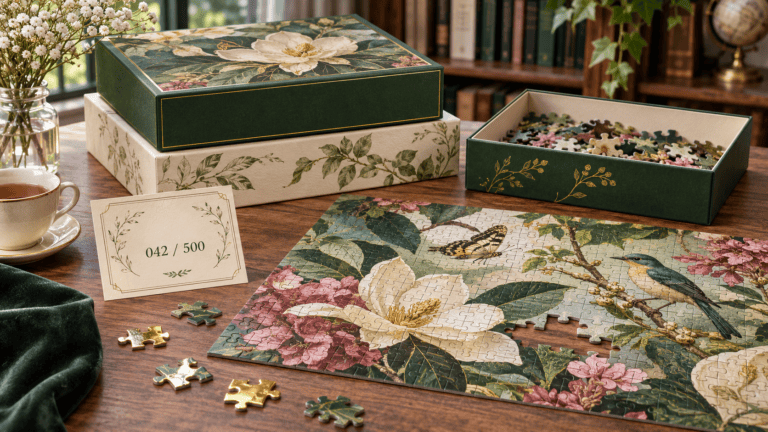
- of a decorative object
- The volume structure is
- A wood-based mechanism
- or even a visual experience without a final model
The puzzle then becomes a puzzle. objectSometimes a sculpture, sometimes a design element, blurring the lines between play, art and decoration.
5. The puzzle sometimes reveals the very nature of people
Putting together a puzzle with multiple pieces is often revealing.
There are those who make decisions in a systematic way, those who want to do everything themselves, those who test every piece without looking at the image, and those who make themselves the orchestra’s leaders.
Behind its seeming calm, the puzzle sometimes acts like a a discreet mirror of personality ⁇ for the best… or for a few fun smiles.
In conclusion
The puzzle is much more than just a hobby. Originally a pedagogical object, refuge at certain times, social activity or creative support, it has never ceased to evolve with usages and expectations.
These little surprises are also part of what makes the puzzle still so current ⁇ and still so fascinating.
Échanger autour de cet articleUne question ou une expérience à partager ?