
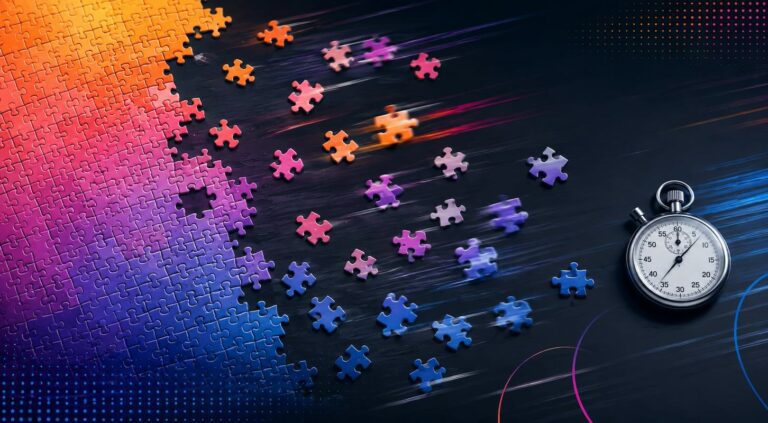
Speed depends not only on the ability to recognize the pieces, but also on the method, sorting, organization of space, stress management and the ability to make good decisions quickly. If you are still learning about discipline, start with our guide: Start the speed puzzle.
Here are the 10 of the most common mistakes that slow down beginners in speed puzzlingAnd most importantly, how to avoid them.
1. Spending too much time on the sidelines
It’s probably the most classic error. Many puzzlers have learned to always start with the edges. In leisure puzzle, it’s often a good habit. In speed puzzle, it’s not always the fastest strategy.
On some puzzles, the edges are easy: sky, colored frame, obvious shapes. But on others, they can be very slow, especially if the image contains repetitive, dark or little contrasting areas.
The problem is that a beginner can spend 10 or 15 minutes looking for the last pieces of the board when he could have built several much easier interior areas.
How can we avoid that mistake?
Start by pulling out the edges, but don’t stay stuck on it. If part of the frame doesn’t come quickly, leave it aside and move on to the most recognizable areas of the image.
In speed puzzling, the goal is not to follow a perfect rule, the goal is to save time.
2. To sort too precisely from the beginning
Sorting is essential, but too detailed sorting can become a waste of time. Many beginners want to create too many small groups: light blue, dark blue, blue with texture, blue with white line, blue with shadow, etc.
The result: they spend more time organizing the pieces than putting together the puzzle.
A good sorting should help build, not become a separate activity.
How can we avoid that mistake?
Start with a simple sort:
- the edges;
- main colours;
- highly recognisable areas;
- texts, faces, objects or details;
- Hard to keep for later.
You can refine the sorting during the puzzle, when you understand the image better.
3. Not looking at the box enough
Some beginners try to assemble almost exclusively from the pieces.
It helps to understand where colours, textures, objects and transitions are located.
In speed puzzling, looking at the box is not a waste of time.
How can we avoid that mistake?
Before you start, take a few seconds to analyze the image:
- What are the big areas?
- Which parts seem easy?
- What parts are likely to be slow?
- Are there any lines, objects or details that can serve as a reference?
During the assembly, check the box regularly to check your assumptions.
4. Trying to finish everything zone by zone
Many beginners choose a zone and want to finish it before moving on to something else.
If one area is blocked, insisting too long slows down the whole puzzle.
How can we avoid that mistake?
If you’re stuck for more than a minute or two, change your zone.
A good strategy is to build the easy areas first and then use those areas as benchmarks to solve the more difficult parts.
5. Lack of organization in the workplace
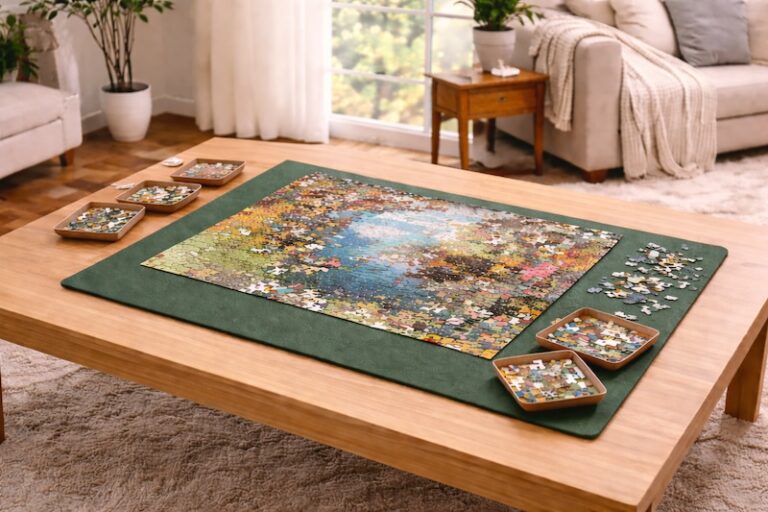
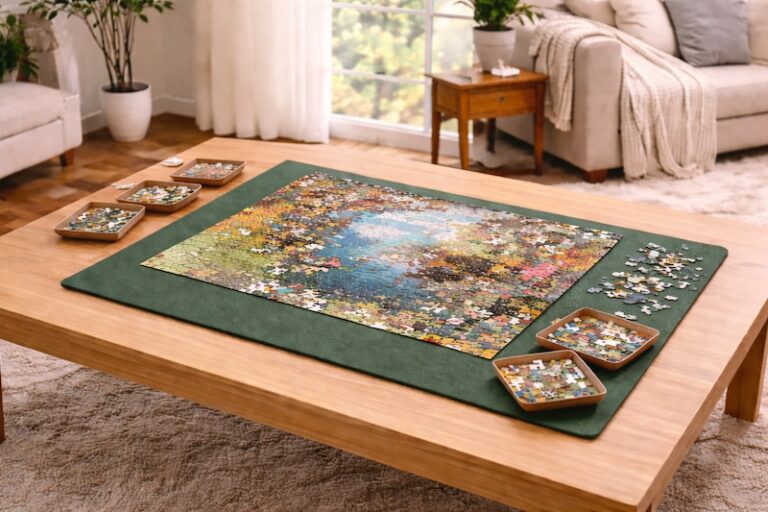
If the table is not organized, you waste time searching for the pieces, moving groups, or making room.
A common mistake is to lay the pieces around in a logical way, and after 20 minutes, the table becomes confused and each search takes more time.
How can we avoid that mistake?
Keep an organization simple:
- the edges on one side;
- the main colours by area;
- the most recognisable pieces separately;
- the central assembly space;
- The hard parts in a specific area.
The aim is to be able to quickly find a family of rooms without thinking.
6. Neglect the shape of the pieces
Beginners often only look at the image: color, pattern, detail. This is normal, but in speed puzzling, the shape of the pieces quickly becomes a major advantage.
When a region is visually difficult, the shape can save a lot of time. Some pieces have two holes, three bumps, a long shape, a strange cut, or a very particular orientation.
Ignoring these clues requires testing too many random pieces.
How can we avoid that mistake?
As soon as you build an area, look at the shapes available around:
- Are we looking for a room with two hoses?
- A horizontal room ?
- A room with a very marked hole ?
- A nearly flat room?
- A very specific interior deck ?
Color gives you a family of pieces, shape helps you find the right one.
7. Moving blocks too often
When you put together several small areas, you sometimes have to move them to connect them, but moving the blocks constantly can be a waste of time and can break the rhythm.
Worse still: if you put an area in the wrong place from the start, you’ll have to move it several times.
How can we avoid that mistake?
Before you lay a block, look at the box and estimate its general position.
On a 500 piece puzzle, quickly realize:
- from above and below;
- central areas;
- corners;
- a large amount of colour;
- the main objects.
A rough but logical placement avoids many unnecessary manipulations.
8. Panic when time changes
Many beginners start well and then they shrink as soon as they feel they are late.
They test the pieces too fast, change strategy for no reason, mix their sorting or forget to look at the image. Result: they go faster in their gestures, but less fast in their actual progress.
How can we avoid that mistake?
Speed puzzling is not just a matter of speed. It’s a matter of rhythm.
When you block, don’t panic.
- Go back to the box .
- change of area;
- Remove a small battery;
- Look for the missing shapes;
- Put together an easy zone to re-start the pace.
A calm puzzler is often faster than a restless puzzler.
9. Never repeat the same puzzle
Many beginners time a puzzle once, then immediately move on to the next one.
Re-creating the same puzzle helps you understand what slowed you down the first time, you better recognize the image, you improve your sorting, you test another strategy and you actually see your progress.
How can we avoid that mistake?
Pick a few puzzles and repeat them several times.
For example:
- first attempt: discovery;
- Second attempt: better strategy;
- The third attempt: optimisation;
- Fourth attempt: personal record goal.
Although repetition does not replicate the conditions of a competition with an unknown puzzle, it is a great help in developing the right reflexes.
10. Not analyzing time after the session
To time a puzzle is good, to understand its time is even better.
A beginner can finish a puzzle in 55 minutes, be satisfied or disappointed, and then pack the box up without analyzing anything, but the best progress leads are often visible right after the session.
You have to wonder where the time has gone.
How can we avoid that mistake?
After each puzzle, quickly note:
- the final time;
- the most convenient areas;
- the slowest areas;
- the sorting errors;
- the times you were stuck;
- What you’d do differently next time.
These notes do not need to be long. A few lines are enough to progress much faster.
Bonus: wanting to go fast before being effective
It’s the mistake that sums up all the others. Many beginners think that speed puzzle is about moving their hands as quickly as possible. In reality, the best puzzles aren’t just fast: they are effective.
They look less randomly, they sort better, they change zones at the right time, they use the box smartly, they know when to insist and when to switch.
Speed often comes after the method.
How do you get ahead in speed puzzling?
To improve your time, start by working on three simple habits:
- Prepare a strategy before you throw the puzzle
Look at the picture, identify the easy areas and spot the traps. - Remain flexible during assembly
If a zone is blocked, change sides instead of wasting several minutes. - Analyze each session afterwards
Write down what slowed you down and try another approach next time.
Speed puzzling is a mixture of technique, observation and time management. The clearer a method is developed, the faster your gestures will naturally become.
The Commission
Beginners in speed puzzle are not slowed down by their lack of experience. They are often slowed down by small habits: too much emphasis on the edges, too finely sorting, neglecting the box, panicking in front of the clock or never analyzing their time.
The good news is that these mistakes are corrected quickly. With a better organization, a more flexible strategy and a little bit of training, it is possible to save several minutes on a 500 piece puzzle without necessarily going faster at the physical level.
In speed puzzling, real progress often starts when you stop wondering how to assemble fasterAnd we ‘re starting to wonder how to waste less time.
See also:
Échanger autour de cet articleUne question ou une expérience à partager ?