
Sport evokes movement, effort, progression, sweat, goals and performance. The puzzle seems calmer, slower, quieter. You sit down, you observe, you sort the pieces, you move slowly.
And yet, in my daily life, these two universes complement each other perfectly.
This is also a large part of what it represents. The Puzzle Fit The idea that one can take care of oneself through movement, but also through more calm, more attentive, more mind-oriented moments.
I have discussed this idea more generally in my article on the links between the two puzzles and well-beingHere I wanted to share a more personal version: how puzzles became, for me, a real mental counterweight to a life of sport, screens and goals.
This was also the point of view of the Wentworth Puzzles, which recently mentioned me on his blog in an article about the link between puzzles, balance and well-being. This moment m
A long life structured by movement
For a long time, my daily life was very much marked by physical activity.
CrossFit, Olympic weightlifting, dance, structured training, technical progress, rehearsals, goals: sport has always been an important part of my life.
And in sports, everything is often measurable.
We’re measuring the loads.
We’re counting the rehearsals.
We’re keeping up with the times.
We’re comparing the performance.
We’re trying to make progress.
This structure can be extremely motivating. It gives a framework, direction, a clear feeling of evolution. We know where we are, what we want to improve, and what we need to do to move forward.
But over time, I also felt the need for another type of space. A space where there was no question of performance. A space where I could stay focused without trying to beat a record. A space where calm was as valuable as progress.
That’s where puzzles came into their own.
What the puzzles brought me
Puzzles didn’t come to replace sports. They came to balance it.
Where training pushes me to move, to produce an effort and to measure my progress, the puzzle invites me to slow down. He asks me to observe, to wait, to trust the process.
With a puzzle, there is not always a need for a precise lens. You can simply open the box, spread the pieces, start sorting, and let the image appear gradually.
This change of pace has done me a lot of good.
In a very connected life, where one spends hours in front of a screen, the puzzle creates a different moment. It occupies hands and minds, but in a softer way. It requires attention, but without noise, without notification, without external pressure.
It’s become a form of active disconnection for me.
The mention on the Wentworth Puzzles blog
This link between puzzles, sports and balance was recently highlighted in an article published on the Wentworth Puzzles : Finding Balance: How Puzzles Help Care for Both Body and Mind.
In this article, Wentworth Puzzles shares my experience around a topic that is particularly close to my heart: how puzzles can help take care of the mind, in addition to an active and physical life.
J的y talks about the need to slow down, find a space away from the screens, and discover another form of concentration. Where sport brings structure, movement and progression, the puzzle offers a more calm, visual and immersive pause.
This is exactly what I am trying to convey with The Puzzle Fit The puzzle is not just a hobby, it can become a tool for balance, a moment of mental recovery, and a simple way to reconnect with yourself.
A Different Focus from Sport
In sports, concentration is often linked to execution.It must be precise, fast, strong, stable, explosive or enduring.
In the puzzle, the focus is quieter.
You have to look at the details, recognize the shapes, understand the colors, spot the textures, memorize the image.
What I like about this form of concentration is that it doesn’t rush. It doesn’t require the same intensity as training.
The table, the rooms, the picture.
The rest is secondary.
There is something very satisfying in seeing an image take shape, piece after piece. It is not instant. It is not always easy. But it is progressive, concrete, almost meditative.
The puzzle as a mental recovery
Physical recovery is often discussed as sleep, stretching, eating well, and letting the body rest after exercise.
But mental recovery is just as important.
After a day full of work, content, screens, messages or goals, my mind sometimes needs another rhythm. Not necessarily to do nothing, but to do something quieter.
The puzzle exactly meets that need.
It allows me to stay active without being in the performance, to focus without pressure, to do something tangible with my hands, away from the endless scrolling of screens.
That’s why I often see the puzzle as a form of mental recovery. It does not empty the mind in the sense that it no longer thinks of anything. On the contrary, it directs it towards a simple, visual and soothing task.
The link to The Puzzle Fit
The name The Puzzle Fit It’s just getting more and more meaningful for me over time.
At first, you might see it as a simple mix of puzzles and fitness, but for me, it’s mostly a balance idea.
There is the fitness side: movement, discipline, energy, training, body.
And there’s the puzzle side: calmness, attention, patience, observation, spirit.
Both are not opposed.
On the contrary, they respond. Sport helps to take care of my body. Puzzles help to take care of my mind. Together, they create a form of balance that suits me much better than a life that is only directed towards performance or only to rest.
This is also what I’m trying to share through this blog: the puzzle can be a hobby, a challenge, a passion, a competition, but also a tool for well-being.
From performance to pleasure
What also struck me with the puzzles was the relationship to the process.
In sports, although the process is important, we often look at the results: how many pounds, how many repetitions, how much time, how much progress.
With puzzles, the end result is obviously there, you want to see the picture finished, but a lot of the fun is in the way.
Sort the pieces.
I’ll see what I can tell you.
Finally find a long-sought piece.
Connecting two areas.
See the image appear gradually.
The puzzle taught me to appreciate small steps more, and it reminded me that progress can be made without measuring everything, without comparing everything, without always seeking to optimize.
And that’s something I try to keep in other areas of my life, too.
Slow puzzling and speed puzzling: two different needs
What may seem paradoxical is that I also like speed puzzling.
I like to run a timeline, test a strategy, try to improve a time, understand what slowed me down, so this performance aspect also exists in my puzzle practice.
But for me, slow puzzling and speed puzzling are not over.
The speed puzzling It fuels my desire for progress, method and challenge.
The slow puzzling It fuels my need for calm, presence and disconnect.
Some days I want a challenge, and other days I want to set the time and just enjoy a nice puzzle.
It’s this freedom that makes the puzzle so rich.
Why Wooden Puzzles Have a Special Place
The wood puzzles play a special role in this quest for balance.
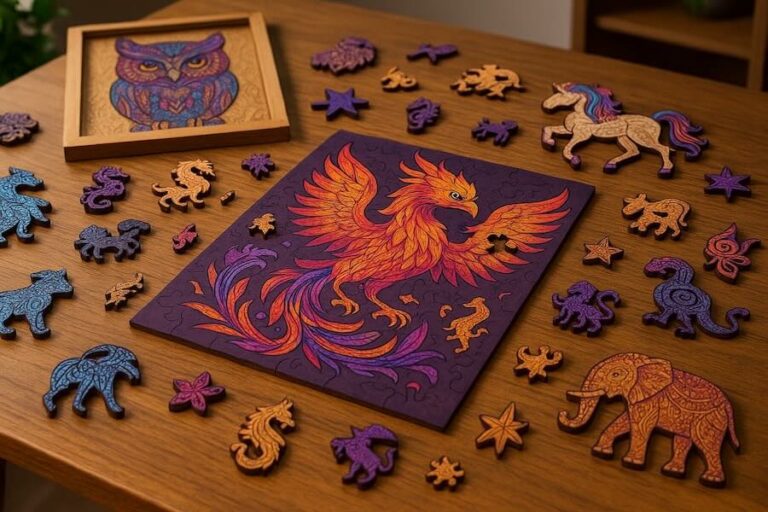
Their texture, their cutting, their weight, their irregular shapes and their thematic pieces naturally invite to slow down. They are not quite treated as a classic puzzle. We take more time to look at the pieces, to manipulate them, to appreciate their shape.
This is also what I like about Wentworth puzzles: they encourage a more sensory and attentive way of puzzleting. The pleasure comes not only from the finished image, but also from the touch, shapes, cuts and full experience.
As Ambassador Wentworth Puzzles, this approach speaks to me a lot. She perfectly agrees that puzzles can be both beautiful, stimulating and soothing.
You can use my code. PETER1026 to benefit from 10% discount on the website of Wentworth Puzzles.
What puzzles have changed in my routine
Puzzles have helped me integrate more screenless moments into my daily life.
Instead of finishing some days while scrolling without really resting, I can install myself in front of a puzzle. Even 20 or 30 minutes are sometimes enough to change the rhythm of the evening.
It’s not spectacular, it’s not a radical change, but it’s what makes this habit lasting.
The puzzle is simple, accessible, flexible, you can go back to it whenever you want, you can do a long session or just a few pieces, you can look for a challenge or just a quiet moment.
For me, it’s become a small habit that helps me keep a better balance.
The Commission
Puzzles came into my life as a hobby, but they became much more than that.
They have become a mental counterweight. A way to slow down in a fast daily life. An activity without screen. A space of calm concentration. A way to take care of my mind, in addition to sport and movement.
Sport helps me feel strong, active and anchored in my body.
Puzzles help me feel calm, focused and present.
And between the two, I found a form of balance that perfectly matches what The Puzzle Fit It’s what it means to me.
You can read the original article on Wentworth Puzzles’ blog here: Finding Balance: How Puzzles Help Care for Both Body and Mind

Échanger autour de cet articleUne question ou une expérience à partager ?