
A 500-piece puzzle can be done almost everywhere. A 1000-piece puzzle already requires a more serious space. From 1500 or 2000 pieces, the support becomes a real subject. And for a 3,000-piece puzzle, it is better to anticipate before opening the box.
In this guide, we’re simply looking at: which support to choose for a 500, 1000, 1500, 2000 or 3000 piece puzzle? Table of puzzlesThe main features of each format are: rolling mat, rigid board, tilting board, XXL support or home solution.
In short: what support to choose according to the number of pieces ?
| Number of coins | Recommended support | What to Avoid |
|---|---|---|
| 500 pieces | Plate, small board, classic table | Buy a large dedicated table if you you ‘re out of space |
| 1000 pieces | The following table sets out the following elements: | Surface too small or table used daily |
| 1500 pieces | Table tilted, large board, tray with drawers | Carpet too flexible or hard to move |
| 2000 pieces | Table of puzzle 2000 pieces, XXL board, rigid board | Low table too narrow or no margin support |
| 3 000 pieces | Large board, XXL carpet, dedicated surface, DIY solution | Most classic puzzle tables |
| 4000 pieces and more | Large dedicated table, custom panel, assembly in sections | Mobile support too small or unstable |
The best choice depends on three things: the size of the finished puzzle, the space available at home, and how much you like to puzzle.
If you are doing puzzles of 500 or 1000 pieces, a carpet or a board can be enough. If you do a regular 1500 or 2000 pieces, a real puzzle table becomes much more interesting. For 3000 pieces or more, you often have to switch to a XXL or custom solution.
Why the number of coins is not always enough
You might think a 1000-piece puzzle is always the same size.
Two puzzles of 1000 pieces can have different dimensions depending on the brand, format and illustration. A 1000 classic pieces often measure around 68 × 49 cm, but some panoramic, square or special formats take more space.
The same goes for the 1500, 2000 or 3000 piece puzzles, so before you choose a support, you always have to check the dimensions of the puzzle finished on the box.
The right reflex: provide a margin around the puzzle. It does not only take room for the finished image, but also for unsorted pieces, edges, colors, current areas and sometimes sorting boxes.
500 pieces puzzle support: simple and compact
A 500-piece puzzle is the easiest format to handle on the support side. It can usually be done on a classic table, desk, light board or even a rigid board.
This is the perfect format if you’re running out of space, if you’re working on a nightly puzzle, or if you want to be able to finish your puzzle in one or two sessions.
The best supports for 500 pieces
For a 500-piece puzzle, the most practical supports are:
- a kitchen or living table;
- a light rigid board;
- a compact puzzle board;
- a little puzzle carpet;
- A folding table if you want a dedicated corner.
The puzzle mat can be useful if you need to store the puzzle between sessions. But for a 500 pieces, a simple rigid board is often more pleasant: it stays flat, moves easily and does not require much storage.
Who’s the right guy for this?
The 500-piece support is very good:
- for beginners;
- accompanying children;
- people who occasionally do puzzles;
- small apartments;
- I’m not sure if I’m going to be able to do that.
If you rarely make more than 500 pieces, you do not necessarily need to buy a large specialized table.
1000 pieces puzzle support: the format where choice becomes important
The 1000-piece puzzle is the classic, and that’s when the support starts making a real difference.
A 1000 pieces already takes a good part of a table. If you use the table in the living room or kitchen, you may soon have to move the puzzle, cover it or store it in an emergency.
The best supports for 1000 pieces
For a 1000 piece puzzle, the best options are:
- The puzzle rug
Pretty practical if you want to put the puzzle together without monopolizing a table. - The rigid board
Very comfortable if you have a place to lay it flat. - The puzzle board with drawers
Ideal if you like to sort your pieces by color, shape or area. - The little puzzle table
The best choice if you often do 1000-piece puzzles. - The compact tilting table
Interesting if you want more visual comfort and less slant.
Mat or board for a 1,000-piece puzzle?
For a 1000 pieces, the carpet is convenient, but not always the most comfortable. It allows you to roll the puzzle, but the surface can be a little soft. The pieces do not always slide as on a board and the storage requires a little care.
The rigid board, on the other hand, provides a more stable surface, often more comfortable for assembling parts, but takes up more space for storage.
In short:
| Support | Benefits | Limitations |
|---|---|---|
| The carpet puzzle | Easy to store | Less rigid |
| Strict board | Very stable | More crowded |
| Table of Puzzle | Very comfortable | More expensive |
| Plates and drawers | Integrated tri | Can be heavy |
If you do a puzzle every now and then, a carpet may be enough. If you do a puzzle every week, a board or a small table will quickly become more comfortable.
1500 pieces puzzle support: the right compromise for regular puzzle players
The 1500 pieces puzzle is a bit tricky. It looks close to the 1000 pieces, but it requires a lot more space. The family table quickly becomes just, especially if you want to sort the pieces around.
It is often from 1500 pieces that a tilting puzzle table, a large board or a tray table becomes really interesting.
The best supports for 1500 pieces
For a 1500 piece puzzle, I recommend instead:
- a 1500 piece puzzle table;
- a large rigid board;
- a jigsaw board;
- a table with drawers;
- A XXL mat if you absolutely have to keep it.
A 1500-room puzzle table is often more realistic than a 2000 or 3000-room table. It remains large enough to be comfortable, but not necessarily huge to the point of becoming impossible to place in an apartment.
Why inclination becomes interesting
On a 1,500-piece puzzle, you spend more time leaning over the support, so a tilting table can really improve comfort.
It helps to see the image better, to bend back less and to work longer without fatigue. It is particularly useful if you do puzzles regularly or if you tend to have a pain in the neck or shoulders.
However, be careful: not all tilting tables are suitable.
- the stability;
- the actual size of the tray;
- the presence of a rim to hold the parts;
- The angle of inclination;
- the facility of storage;
- whether or not there are drawers.
2000 pieces puzzle support: you need a real surface
With a puzzle of 2,000 pieces, you’re in another category, and the required surface area is much larger, and the conventional media quickly become limited.
A standard carpet for 1000 pieces will not be enough. A small board will not be enough either. A large, stable support is needed that can accommodate not only the finished puzzle, but also the pending pieces.
The best supports for 2000 pieces
For a 2000 piece puzzle, the best options are:
- A puzzle table of 2000 pieces
It’s the most comfortable choice if you have the space. - A big one puzzle board 2000 pieces
Good alternative if you want a simpler and cheaper solution. - A large, tilting table
Very nice for comfort, as long as the tray is wide enough. - A tray with integrated drawers or trays
Pretty good at organizing the rooms. - A large DIY area
For example, a MDF panel, a large plate or a dedicated table.
Table or board for 2,000 pieces?
For a 2000 pieces, a puzzle table is more comfortable, but it requires space and a higher budget. A XXL board is simpler, often cheaper, but it needs to be stored somewhere.
If you make several large puzzles a year, the dedicated table is a real comfort. If you make a 2000 pieces occasionally, a rigid board can be sufficient.
| The solution | – Who ‘s it for ? |
|---|---|
| Table puzzle 2000 pieces | Regular Puzzles, Need for Comfort |
| Puzzle board 2000 pieces | More reasonable budget, simpler solution |
| Carpet XXL | Storage needs but less rigidity |
| DIY panel | The Commission has already adopted a number of proposals. |
For this format, drawers are also becoming very useful, allowing you to keep the pieces sorted without invading the whole room.
3000 pieces puzzle support: beware of false good ideas
The 3000 pieces puzzle is one of the most problematic formats for choosing the medium.
Many online puzzle tables are available for 1000, 1500 or 2000 pieces. Sometimes they can accommodate a part of a 3000 pieces, but rarely the complete puzzle with enough margin to work comfortably.
Before you buy a table with the idea of making 3,000 pieces on it, always check the dimensions of the table.
The best supports for 3000 pieces
For a 3000-piece puzzle, the most realistic solutions are:
- a large rigid board XXL;
- a puzzle rug of 3000 pieces;
- a large dedicated table;
- a MDF or plywood panel;
- a solution in several sections;
- a temporary but stable working surface.
The best solution depends mostly on your space.
If you have a dedicated piece, a large fixed table is ideal. If you need to store the puzzle between two sessions, a XXL carpet or a moving board will be more convenient. If you want an economical solution, the custom panel is often very effective.
Can we use a puzzle table for 3,000 pieces?
Yes, but be careful, some large tables or trays may be fine, but many models called ⁇ XXL ⁇ remain too small for a real 3000 pieces.
The problem is not only the size of the puzzle finished. You also have to be able to sort the pieces and work around. If the puzzle just gets back on the stage, the experience may be frustrating.
For a 3000 piece, I recommend providing a generous margin and giving preference to stability over mobility.
For a more detailed guide, see our article: Best puzzle media 3000 pieces.
Support for puzzles 4000, 5000 pieces and more: customized space
The conventional media quickly shows its limits when it comes to pieces over 3,000, and puzzles of 4,000, 5,000, or 6,000 pieces often require a specific organization.
At this level, you have to think like a small development project.
The best solutions to very big puzzles
For big puzzles, the best options are:
- a large dedicated table;
- a MDF board on trusses;
- a plaque of plywood;
- several assembled boards;
- a system for sorting by box;
- a zone assembly;
- a room or corner reserved for several weeks.
The simplest solution is often the tailored panel, which can be placed on a table, on trusses or on a temporary surface.
Do we have to do the puzzle in sections?
For very big puzzles, yes, it’s often the best method.
Many large puzzles are designed with separate visual areas or bags. Even when this is not the case, working in sections helps to limit the congestion.
For example , you can sort:
- the edges;
- the dominant colours;
- the skies;
- the text areas;
- the characters;
- the repetitive details;
- the special shaped parts.
The bigger the puzzle, the more important the sorting becomes.
The different types of puzzle media
Now that we have seen the formats, let us look at the main media available.
The puzzle rug
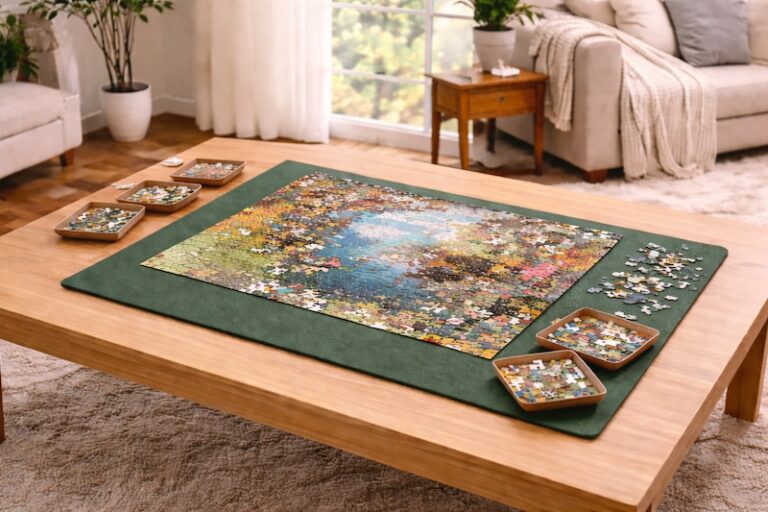
The a puzzle rug It is one of the most popular solutions, which allows you to start a puzzle and then roll it up and store it without losing all the work already done.
Benefits
- It’s not that awkward once you’ve put it in a row.
- It’s often cheaper than a table.
- Pretty good for small spaces.
- Available in several sizes.
- Useful for puzzles of 500 to 3000 pieces depending on the model.
Limitations
- Less rigid surface.
- Sometimes it’s a tricky ride.
- The pieces can move slightly.
- Less pleasant for big puzzles.
- Not ideal if you like to sort a lot of pieces around.
The carpet is especially suitable for people who lack space and want to be able to quickly clear the table.
The puzzle board
The puzzle board It can be bought as a puzzle medium or made by itself with a suitable plate.
Benefits
- The surface is rigid.
- Very stable.
- Easy to use.
- It’s cheaper than a specialized table.
- It’s possible in large format.
Limitations
- It can be a lot of work to store.
- It’s not always easy to move around.
- Not necessarily drawers or built-in storage.
- It needs a surface to lay it on.
The board is one of the best solutions for 1,000, 1500, 2,000, even 3,000-piece puzzles.
The puzzle board
The puzzle board is a more elaborate version of the board. It may include edges, a lid, drawers or sorting boards.
Benefits
- Surface is stable.
- Often more convenient than a simple board.
- It may include storage.
- Easy to put on a table.
- Good compromise between carpet and table.
Limitations
- Weighs more than a rug.
- Sometimes limited size.
- It can be a little cumbersome.
- Big models are more expensive.
The set is very interesting for 1,000 to 2,000-piece puzzles.
The puzzle table
The Table of puzzle is the most comfortable solution if you puzzle regularly.
It can be fixed, foldable, and bent, with drawers, wheels, or a lid, and some models look like real little puzzle stations.
Benefits
- Very comfortable.
- Dedicated surface.
- Perfect for regular puzzle players.
- Some models are tilted.
- The drawers make it easier to sort.
- The wheels move the table.
Limitations
- It’s more expensive.
- Ask for the seat.
- The dimensions must be checked.
- Many models don’t really go beyond 1,500 or 2,000 pieces.
The table is ideal for 1,000, 1,500, 2,000-piece puzzles, and for 3,000 pieces, you have to pay much more attention to the dimensions.
The puzzle triggers
The triggers don’t replace a support, but they complement it very well.
They allow you to separate the pieces by color, shape, area or texture. They are particularly useful from 1000 pieces, and almost essential for large puzzles if you like to stay organized.
Benefits
- They make it easier to sort.
- Avoid scattering the coins everywhere.
- Reduce the risk of losing coins.
- Very useful for complex puzzles.
- They can easily be stored.
Limitations
- Do not replace a large area.
- They can take up space around the support.
- Less useful for small, quick puzzles.
Trieers are particularly useful with a puzzle table, a wide board or a tray table.
What area should you predict based on the number of pieces?
Here are indicative dimensions. They can vary by brand and format, so always check the exact dimensions on the box.
| Number of coins | Frequency of the completed puzzle | Advised support surface |
|---|---|---|
| 500 pieces | Approximately 49 × 36 cm | At least 60 × 45 cm |
| 1000 pieces | About 68 × 49 cm | At least 80 × 60 cm |
| 1500 pieces | About 80 × 60 cm | At least 95 × 70 cm |
| 2000 pieces | About 98 × 75 cm | Not less than 110 × 85 cm |
| 3 000 pieces | About 120 × 85 cm | At least 135 × 100 cm |
| 5000 pieces | Variable, often very large | Dedicated or customized surface |
The simple rule: add at least 10-15 cm of margin around the puzzle if possible. This margin is used to manipulate the pieces, organize the edges and avoid working in too tight a space.
What kind of support do you have to choose if you don ‘t have room ?
If you’re short of space, the best support is not necessarily the biggest, but the one you can actually use without interfering with your daily life.
In a small apartment
The best options are:
- a ‘Page’ is a piece of paper or paperboard;
- a fine sliding board under a bed;
- a plate with a lid;
- a folding table;
- support to be laid on an existing table.
Avoid large fixed tables if you don’t have a dedicated corner. Even if they’re comfortable, they can quickly become overwhelming.
If you have to put the puzzle together every night
Choose instead:
- a rolling carpet;
- a board which is easy to move;
- a plate with a lid;
- a wheelchair;
- A folding table.
The most important criterion will be ease of storage, and a perfect but unmovable support will often go unused.
If you have a dedicated room
In this case, the puzzle table becomes very interesting. You can leave your puzzle running, keep the pieces sorted and pick it up again whenever you want.
A table with drawers, wheels, or slopes can be a real comfort.
What support to choose for a child?
For a child, it is best to prefer a simple, stable, and easy-to-store support.
For small puzzles, a classic table or board is enough, but for puzzles of 100 to 500 pieces, a light board can be very convenient.
Avoid too large, too heavy or too slanted supports.The aim is to make the activity pleasant, not complicated.
What kind of support do you want for a senior?
For a senior, comfort is essential.
A sloping puzzle table can be very useful because it limits the sloping posture. A good working height is also important. If the table is too low, the puzzle quickly becomes tiring.
The criteria to be preferred:
- stable surface area;
- good height;
- slight inclination;
- adequate lighting;
- accessible drawers;
- The ability to cover or protect the puzzle.
A support with a curve can also prevent parts from falling too easily.
What kind of medium to choose for the speed puzzling?
For speed puzzling, the support must be fast, clear and very stable.
Competitionrs often use a simple, flat and large table to sort quickly. The goal is not necessarily to have drawers or carpets, but rather an efficient surface where the pieces slide well.
A classic table may be sufficient for training, but it must be well lit and at a good height.
Triers can help with training, but in competition, speed of handling is often preferred.
Mistakes to Avoid
Choosing a medium that is too small
If the puzzle comes right in, you won’t have enough room to work.
Confounding support size and useful size
Some products are advertised as being large, but the actual surface area is smaller because of the edges, drawers or angles.
Buy a 2,000-piece table to make 3,000 pieces
Some tables may seem large, but a 3000-piece table often takes much more space than you think.
Forget about storage
A support can be perfect during assembly, but it can’t be stored afterwards.
Neglecting Height
A poor working height can cause fatigue, back pain or discomfort.
Our final advice
To choose the right puzzle medium, always start from your usual format.
- If you are making mostly 500 pieces, stay simple: a table, a tray or a small board is enough.
- If you’re mostly making 1,000 pieces, the best compromise is often a rigid board, a quality rug or a small puzzle table.
- If you make 1500 pieces, a table or a tray with drawers becomes really interesting.
- If you’re making 2,000 pieces, you should prefer a really large area: a dedicated table, XXL board or rigid board.
- If you’re making 3000 or more pieces, check all sizes before you buy. Standard supports are often too small, and a DIY or custom solution may be more appropriate.
The best media is not necessarily the most expensive, but the one that matches your puzzling style, your space, and the number of pieces you make the most often.
To go further
- Getting a finished puzzle
- Keeping a Puzzle
- What place do you have for a puzzle?
- The puzzle support 3000 pieces
⁇ Puzzle support FAQ
What’s the best support for a 1000-piece puzzle?
For a 1000 piece puzzle, the best support is often a rigid board, a good size puzzle mat or a small puzzle table. If you lack space, the carpet is convenient. If you are looking for comfort, board or table is more pleasant.
How much support does a 1000-piece puzzle need?
A classic 1000 piece puzzle often measures around 68 × 49 cm. It is better to choose a support of at least 80 × 60 cm to keep a comfortable margin.
Can we do a 2,000-piece puzzle on a regular table?
Yes, if the table is big enough and you can keep it occupied for days, but a normal table becomes limited if you also have to sort the pieces around the puzzle.
Is there a puzzle table for 3,000 pieces?
There are some large supports compatible with some 3000-piece puzzles, but many classic puzzle tables are planned for 1000, 1500 or 2000 pieces. For a 3000 pieces, you have to check precisely the useful surface.
Carpet or puzzle table: what to choose ?
The carpet is better if you’re short of space and you have to put the puzzle together often. The table is better if you’re regularly puzzle and want more comfort. The rigid board is a good compromise between the two.
Is a puzzle board enough ?
Yes, a puzzle board can be an excellent solution, especially for puzzles of 1000 to 3000 pieces.
What kind of support do you want to use to keep your coins from falling apart?
A table with edges, a table with drawers or puzzle trays are the best solutions.
Can we make his own puzzle board?
Yes. A plate of MDF, plywood or a large rigid panel can make a very good puzzle support. It is often an economical solution for large formats, including 2000 or 3000 pieces.
What kind of support do you want for a 5000-piece puzzle?
For a 5000 piece puzzle, it usually takes a large dedicated surface or a custom solution. A classic table or standard carpet will not be enough. A panel on trestles or a large fixed table is often more suitable.
Do you need a tilting support to make a puzzle?
This is not necessary, but it is more comfortable, especially for puzzles of 1500 pieces and more.
Échanger autour de cet articleUne question ou une expérience à partager ?