
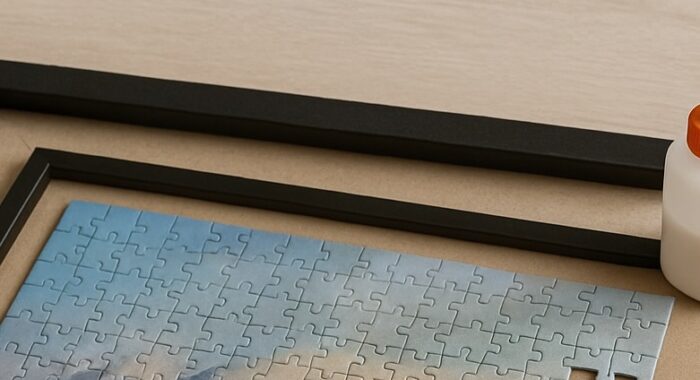
Choose between gluing or pressing
First strategic choice: stick or not stick glue the puzzle. Glue, it’s final. You sacrifice the possibility of doing it again, but you guarantee its stability. If you are of the kind to love things frozen, to want to fix this moment of victory, the glue is for you.
The correct method: use a special puzzle glue, which is applied to the visible surface, such as a varnish. Avoid the usual, overly aggressive liquid glue that can gander the coins. Some glue dries through, fuses the parts together without any fuss, and strengthens the garment. Apply it with a flat spatula, in fine, regular layers. Let it dry for 24 hours. Don’t touch him during this time, even if the temptation is strong.
But if you have a collector’s soul, or if you like the idea of doing this puzzle again in 6 months, the alternative exists: pressing. Basically, you put your puzzle together directly on a rigid support, and then you trap it in a frame between a window and a bottom. No glue, no damage to the building. The point is to choose a frame that fits tightly so that nothing moves. It is clean, reversible, and often undetectable to the naked eye.
A technique inspired by the puzzle framed in Japanese museums or coffee shops: assembly directly on a cardboard, then passing under glass.
The fateful moment: turn (or not) the puzzle
Some tutorials will tell you to turn your puzzle around to stick it back. That’s a bad idea, unless you like the thrill of risking it. It’s like turning a Neapolitan pizza on a hot plate: it passes or it breaks. Even with a sheet slipped over it, even holding your breath, it can bend. Gambling is rarely worth the candle.
If you want to stick it underneath, prefer specific adhesive sheets or book film (stick, discreet, economical). Put them on like a surgeon: on board, no bubbles. This system keeps the parts glue-free and even leaves you the option of a careful re-assembly. Bonus: it is a zero plastic solution if you choose your product well.
The tape can be unwrapped, but it’s a do-it-yourself thing, reserved for the modest puzzles or those you’re not afraid to sacrifice for the test.
Choosing the Right Support and Frame
Do not do your homework with a flying sheet or a cardboard of cereals. Take a real support: a foam cardboard, a medium board, or even a rigid canvas. It must be timely and not gondola-like at the first change in humidity. Clean the surface of the puzzle before fixing it: a small touch of dry cloth will remove any dust that could tarnish your glasswork.
As for the frame, forget about the machines sold in large areas that open once and never close again. Take a frame with real closing clips or metal legs. With or without a strawberry, as you like. The St. Mary’s, this cardboard walk-through, it’s like a gallery. Ideal for irregular-edged puzzles or for those who want to get “breathed”.
The glass? Yes, but be careful with the reflection. The classic glass reflects everything, from the ceiling to the sun of 2 pm. Prefer matte glass, or better, anti-reflective acrylic (and anti-UV, as long as it is there). It is lighter, safer, and it protects the image from discoloration.
Where and how to hang it?
You do not fix a puzzle as a postcard. The wall must be able to carry the weight of the frame. Prefer to well distributed double hooks, especially for large formats. Check that the back of your frame is solid and stable. A light wood frame on rigid background, it is ideal.
The right location is a wall in direct sun shelter, away from heat sources (radiator, fireplace), and out of reach of children armed with felt. An entrance, a hallway, a library are often perfect. And don’t limit yourself to one: framed puzzle walls can transform an entire room. Private gallery effect, memories of quiet moments, and guaranteed discussions.
Finally, think about the future. A puzzle glued, framed, is made to last. But nothing is eternal: check the state of the frame and glass every two years. As a work of art, your puzzle deserves a minimum maintenance.
Discuss this articleHave a question or an experience to share?