Understanding the Connection Between Age, Development and Puzzle
A puzzle is not just a quiet activity to occupy a rainy Wednesday. It is a real tool for cognitive development, especially in children. It involves eye-to-hand coordination, stimulates concentration, structures logic and nurtures the sense of observation. But all this is only possible if the puzzle matches the child’s abilities.
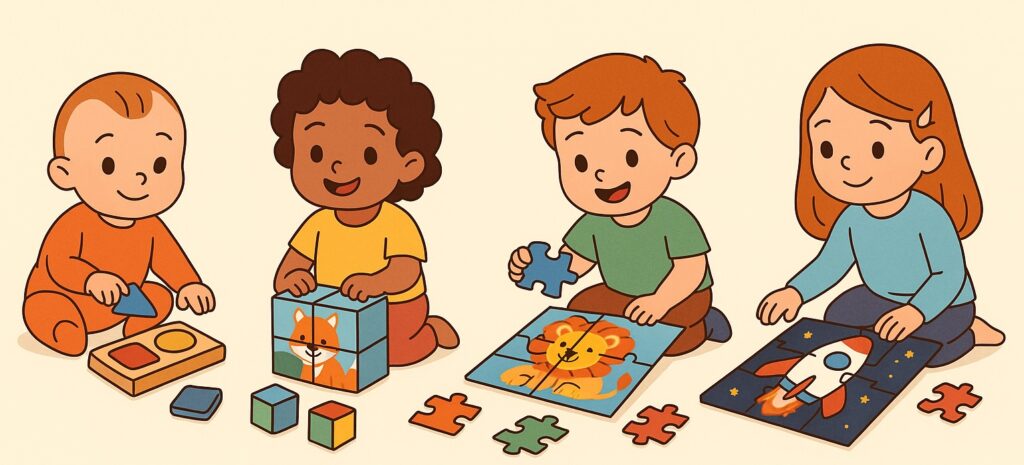
Before the age of 2 years, the child is still in a sensory phase. He’s exploring the world through touch, sight, sound. At this point, we’re not talking about classic puzzles but puzzles with embedded, sound, tactile, with thick, easy-to-handle pieces, often made of wood. These formats allow the child to understand the concepts of shape and volume, to manipulate objects, and to enjoy success.
Between the ages of 2 and 4, children develop their first visual analysis skills. He’s starting to recognize more complex shapes, pieces of drawing. It becomes able to combine several pieces to reconstruct a coherent image. That’s where puzzles with 10 to 35 pieces make sense. This is also the time when the theme begins to play a crucial role. Dinosaur, firefighter, unicorn or truck-benne, the right visual can turn a puzzle into a passion.
At about 5-6 years old, we see a click: the child masteres the contours, starts sorting the pieces by colors or patterns, and takes pleasure in the climb in difficulty. Then we can go up to 100 or even 200 pieces. From there, everything becomes more personal: some children love complex puzzles, others prefer to stay on familiar formats. What matters is that the child is in control of his or her experience. The challenge is not performance, but the pleasure of the challenge.
A table to find
Here is a summary of the types of puzzles recommended according to age groups. It takes into account both the number of pieces, the size of the pieces, and the most suitable formats.
| Age of the child | Number of coins | Type of puzzle | Size of the parts | Recommended support |
|---|---|---|---|---|
| 1 year | 1 à 6 | Embedded puzzle | Very large | Hand held drinks |
| 2 years | 6 à 10 | Puzzle cube / tactile / sound | High | Wood or thick cardboard |
| 3 years | 12 à 24 | Silhouette / evolving puzzle | High | Rigid carton |
| 4 years | 24 à 54 | Observation / evolutionary puzzle | The following is the list of the Member States: | Animated themes, familiar world |
| 5 years | 50 à 100 | Educational Puzzle / Advanced Silhouette | The following is the list of the Member States: | Strong contrast, clear shapes |
| 6 years | 150 à 350 | Puzz ⁇ Art / Gallery | Average to small | Rich themes, complex compositions |
| 7 to 8 years | 300 à 500 | Panorama / fantastic puzzle | Little ones | Quality cardboard, fine details |
| 9 years and + | 500 pieces and + | Adult puzzle, escape puzzle | Little ones | Artistic or narrative challenges |
The visual counts as much as the number of pieces
A poorly printed unicorn puzzle will never compete with a beautifully illustrated dragon. The basic commitment, especially before the age of 7. At that age, children still live in powerful narrative universe They want to find what they love.
Djeco He’s got a good understanding of the puzzle with his castle, robot or pirate ship-shaped silhouettes. Janod It offers scalable boxes with colourful and playful themes. VilacIt is a traditional style, with artistic illustrations and woodwork that appeals to parents as much as to children.
You can also look at the side of:
- Ravensburger, which declines Disney heroes, Paw Patrol or Pokémon on high-quality puzzles.
- Nathan, for his educational puzzles about animals or world maps.
- Or else Crocodile Creek, with its bold visuals and original boxes (often in the shape of an animal’s head !).
From 7 to 8 years old, children start to to leave childish illustrations behind to explore other worlds. L’art, nature, space or fantasy take over. It’s time to introduce more immersive puzzles, richer in detail, even without borders.
Beware of Common Mistakes
Many parents overestimate their child’s abilities by thinking about doing well. 的She’s super resourceful, she’s going to manage 500 plays at 5 years old. 的 Bad idea. A puzzle too difficult causes frustration, sometimes even a total rejection of activity. It is better to choose simpler and to observe ease before moving on to the next step.
Another common mistake is to ignore the size of the pieces. Some puzzles 100 pieces are easier than a 36 pieces poorly calibrated. What counts is the legibility of the image, the consistency of the shapes, and the child’s ability to manipulate the pieces. Always prefer a puzzle that the child can hold alone in his hands.
Finally, do not neglect the collaborative dimension. A puzzle, especially among the 4-6 year olds, can be a game to do with two. The child learns as much from exchange as from assembly. And sometimes, a simple part rotation becomes a moment of complicity.


Discuss this articleHave a question or an experience to share?