Why Wasgij? Junior arrives at the right time
The puzzle for children has for a long time been limited to wise, very literal images: a cat, a fire truck, a princess; what you see is what you assemble. Wasgij? Junior sweeps this logic from a back of hand and poses this almost subversive question: What if the picture of the box was just a lie?
The concept is known to adult fans: in the Original, Mystery or Christmas ranges, you always assemble an invisible scene, something that happens after, elsewhere or from the point of view of another character. Wasgij? Junior’s picking up the mechanics, but simplifying it. Not to infantilize: to initiate. At the age of 8, one is perfectly able to imagine the continuation of a story, to spot visual clues, to understand that a frozen decor can explode in chaos a second later. Is that what Wasgij is? Junior is a real one. The meta-puzzle A game that involves assembling not an image, but an idea.
Where a classic puzzle requires patience, Wasgij? Junior requires in addition to the mental projectionAnd that’s exactly what makes it unique: it puts children in the face of a challenge rarely offered in assembly games.
Puzzles of the big boys with pieces of the kids
The Junior range is a very clever hybrid format: 240 pieces, for a final rendering of approximately 68 × 49 cmIt’s almost the size of an adult puzzle of 1,000 pieces, but with bigger pieces, designed for hands that are still clumsy but already ambitious.
This is a brilliant strategy: to give children the ‘big format’, which means real pride in their arrival, while keeping the resolution time available. We avoid the pitfall of the endless puzzle that ends up in a bunch of forgotten pieces on a coffee table, and we nourish this sensation of accomplishment that makes us want to do another.
The combination of technical simplicity and narrative complexity is perhaps the most successful of this range. We are not in pure difficulty (no immense monochrome areas), but in a space where Every detail can be a clue A horn of ice ready to fall, animals shaking, a customer raising his eyebrows.
The first four titles of Wasgij?
The first wave of Wasgij? Junior is presented as a coherent mini-series, illustrated by Aaron Blecha, known for its lively, cartoonic trait, generous in distorted expressions and slightly hysterical characters. This style is perfect for a narrative puzzle: everything seems about to explode, stumble or fly.
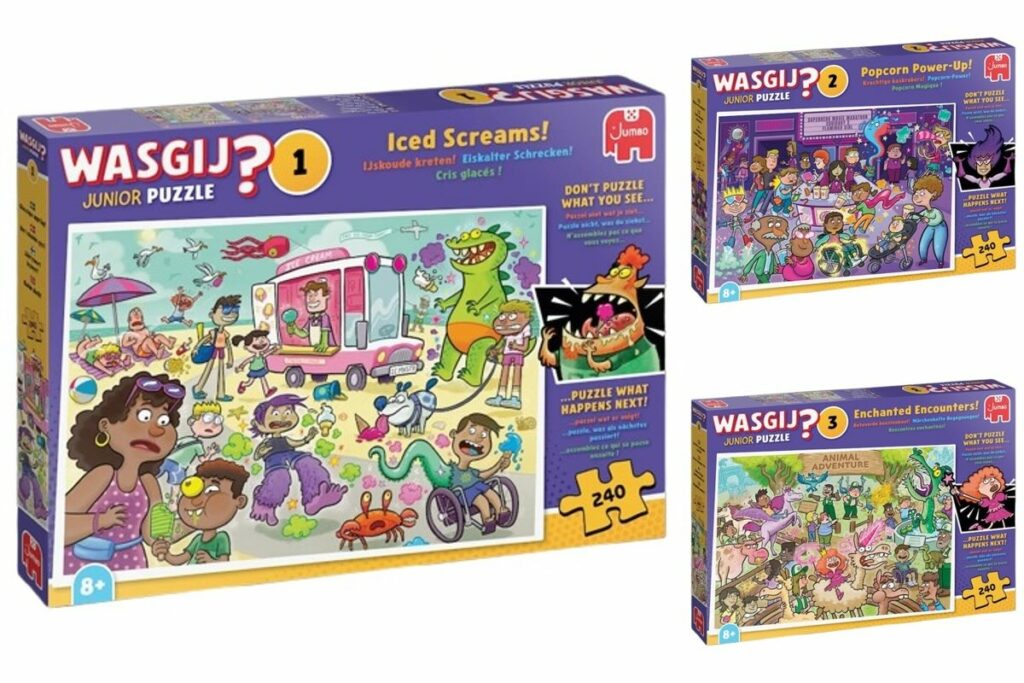
Wasgij Junior 1 ⁇ Iced Screams! / Screaming Ice!
A party setting, overexcited children, melted ice and cascade disasters. It is the perfect puzzle to understand the rule of the game: every visible element in the scene potentially announces the chaos that will unfold in the image to be reconstructed.

Cet article contient des liens d’affiliation. Si vous effectuez un achat via ces liens, nous pouvons percevoir une commission, sans frais supplémentaires pour vous. As an Amazon Associate I earn from qualifying purchases.
Wasgij Junior 2 – Popcorn Power-Up! / Magic Popcorn!
Direction of the cinema, at the counter where nachos, soda and hyperactive popcorn machines are mixed. It’s an extraordinary playground for a Wasgij: the slightest slip can turn the scene into a blown corn geyser. The child understands that the imposed image is only a taste bud literally.

Wasgij Junior 3 Enchanted Encounters!
Here, place to the fantastic: magical creatures, enchanting mini-park, animals that no longer respect gravity. This title further pushes the imagination and encourages the mental creation of a 的after even more crazy. We pass from chaos to the fairytale, without ever losing this red thread: assemble what we do not see.

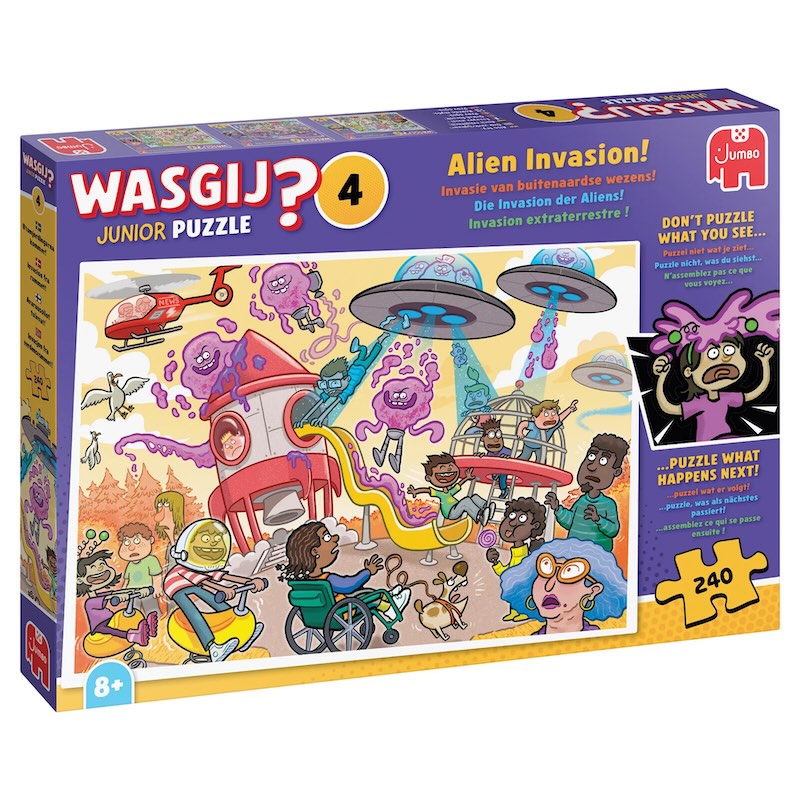
Wasgij Junior 4 ⁇ Alien Invasion! / Alien Invasion!
A perfectly normal day on the playground… until strange shapes appear in the sky. Blue lights, disturbing noises and crowded visitors from elsewhere suddenly come to sow the puzzle. Is it a scientific experiment that goes wrong or is it a real alien invasion ? The child must use his imagination to find out what will happen next. This fourth Wasgij Junior The 240 pieces illustrated by Aaron Blecha perfectly follow the collection principle: observe the clues of the starting image to assemble a scene that you have not yet seen.
A bridge to adult roles (and a future generation of fans)
Wasgij? Junior is not a marketing gadget but a real transmission strategy. Many adult puzzlers say that they discovered Wasgij too late, and would have loved to initiate younger ones. The Junior range creates this opportunity: it prepares future followers of the Original and of Christmas, these hundreds of pieces that turn a peaceful scene into a cyclone of detail.
By introducing the early idea that the picture of the box is not the truth but a riddleThe brand is making a new type of puzzle: more curious, more playful, more attentive to visual storytelling than to simple reproduction.
Why this range could change the way children puzzle
If Wasgij? Junior works, it will be because it finally offers children something that adults have long had: the possibility of being surprised. The puzzle is no longer a repetitive activity, but an open question. It no longer tests only endurance or logic, but it is a very important one. The imaginationAnd in a market saturated with frozen images, this simple idea has something to redistribute the maps.
In summary
- Junior is taking up the iconic concept of the puzzle, which does not show what you put together, but is accessible from the age of 8.
- 240 pieces: a real puzzle of size, but tailored for children.
- Four titles, drawn by Aaron Blecha, each playing on a different chaos.
- A brilliant introduction to adult roles, but still fun, readable and visually generous.
The Commission has also adopted a number of recommendations.
How old can you be to a Wasgij, Junior Puzzle?
8 years or younger if the child is already familiar with puzzles and comfortable with the detailed scenes.
Why a Wasgij, Junior Puzzle with 240 pieces?
Because it’s the perfect balance between ambition and accessibility: enough pieces to create a big dynamic scene, but not too much to discourage the child.
Is it hard to solve a Wasgij, Junior puzzle?
Yes… but just what it takes. The difficulty comes less from the assembly of the pieces than from the interpretation: you have to understand the clues of the starting scene and imagine what happens next.
.nw-product-section{border:0}.nw-product-section .wp-block-image img{max-width:100%;height:auto!important;max-height:300px;object-fit:contain}.nw-product-section .nw-product-offers{align-items:center;text-align:center}.affiliate-product-columns{display:grid!important;grid-template-columns:repeat(2,minmax(0,1fr));gap:24px}.affiliate-product-columns>.wp-block-column{display:contents}.affiliate-product-columns>.wp-block-column>p{grid-column:1/-1}.affiliate-product-columns .nw-product-section{margin-top:0}.affiliate-product-columns .wp-block-image{display:flex;flex-direction:column;align-items:center;justify-content:center;min-height:300px}@media(max-width:781px){.affiliate-product-columns{grid-template-columns:minmax(0,1fr)}} .entry-content figure.wp-block-image{display:flex!important;flex-direction:column!important;align-items:center!important;justify-content:center!important;width:100%!important;float:none!important;margin-left:auto!important;margin-right:auto!important;text-align:center!important}.entry-content .nw-product-image{margin-left:auto!important;margin-right:auto!important;text-align:center!important;max-width:100%}.entry-content .nw-product-offers{display:flex!important;flex-direction:column!important;align-items:center!important;justify-content:center!important;width:100%;text-align:center!important}.entry-content .nw-product-list__merchant,.entry-content .nw-product-list__unavailable{justify-content:center;text-align:center}

Discuss this articleHave a question or an experience to share?