
A box from the north
Trefl was born in Gdynia, on the Polish Baltic coast, in 1985. Its founder, Kazimierz Wierzbicki, did not just set up a toy business: he launched an empire that now affects more than 50 countries, combining puzzles, board games, toys, and even an editorial branch. I mean, we’re not talking about a little artisan. Trefl is industrial, but with a certain flair.
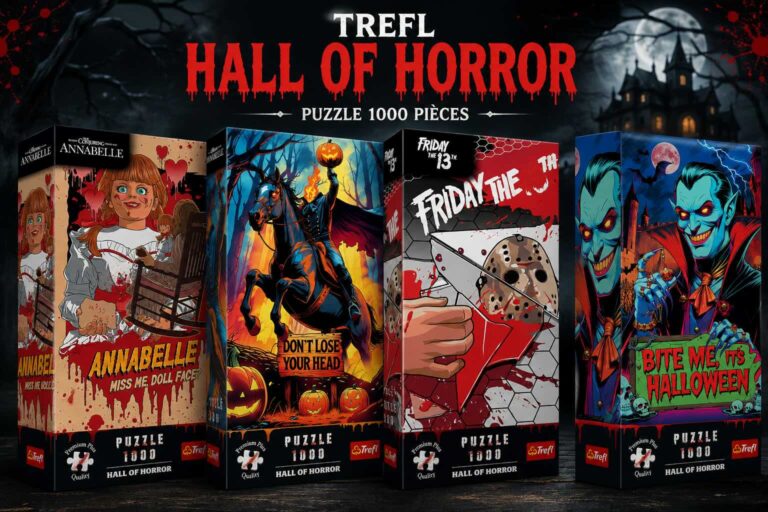
Their catalogue is vast, sometimes too large, and covers all classical formats: 500, 1000, 1500, up to 4000-piece mastodons. Typical images of the European puzzle are: hyper-colored landscapes, photos of cats, Christmas scenes, retouched artworks and, of course, a wide range of official licenses. Disney, Mattel, Hasbro, Viacom ⁇ if you’ve ever made a Snow Queen or Spider-Man puzzle, there’s a good chance Trefl is behind it.
But what makes Trefl really interesting is its willingness to innovate, because yes, even in the seemingly frozen world of the cardboard puzzle, there is still room for progress.
A puzzle, several formats
The Commission has already adopted a number of proposals. The Trefl Prime SeriesThere ‘s a very bad idea behind the marketing name:Unlimited Fit Technology. The principle ? Create modular edge puzzles that can be combined with each other like LEGO plates. Imagine buying two puzzles of 500 pieces and being able to put them together without any visible sewing, like you’re building an evolutionary fresco. It’s kind of a giant patchwork, but it’s neat. It’s bold, and it opens up opportunities for collectors or creatives.
Another important segment is the Wood Craft Origin Line. Trefl offers wooden puzzles, with laser cut pieces and original shapes, often inspired by animals or objects. We are not in the Wentworth-style Scandinavian minimalism, but rather in an accessible craftsmanship, which remains below the 40€ bar for most models. It’s sensory, it’s pretty, and it’s very Instagrammable. Clearly designed to appeal to urban people seeking tactile and disconnected experiences.
Finally, we find the Premium Plus, the high-end version of the cardboard puzzle. Clear cut, precise fit, denser cardboard, less plastic, and ecological commitment with FSC certification. No revolution here, but a solid execution that aims to reassure those who have been scalded by low-cost puzzles sold by shovel on Amazon.
What’s a Trefl coin worth?
The quality of a puzzle is often measured by the moment you place a piece. Is that a click? Is that floating ? Can two pieces fit together without play or friction? At Trefl, the results vary by range. The range entries, particularly those sold in large quantities, may have somewhat approximate cuts. False positives ⁇ these pieces that seem to stick together but don’t go together ⁇ are more common than one would like. But as soon as you get to the top, especially on the Prime or Premium Plus, the feeling changes. The cardboard is stiffer, the cut is more transparent, the image is glued together without bright reflection.
It’s not Ravensburger, let’s be clear. But it’s not the Chinese no-name either. Trefl occupies this intermediate segment which is very interesting for regular puzzle players: good material, varied images, prices. A 1000-piece box is easily found around €10 to €15, a quality/price ratio that few brands in Europe match.
A growing brand
In recent years, Trefl has grown internationally, particularly in the United States, with a dedicated website (TreflUSA.com) and a presence on the main e-commerce platforms. The company has understood the evolution of the puzzle audience: less family, more adult, more urban. It offers more modern designs, artistic collaborations, and more sophisticated visual communication.
The strategy is clear: attract both families, teenagers and those in their thirties who are nostalgic or aesthetic. Clementoni In Italy or Jumbo in the Netherlands: local brands have become global forces by adapting to contemporary codes without losing their DNA.
Trefl even goes further than some competitors with boxes rethought to be stackable, a significant reduction in plastic (more zip bags or plastic films on boxes), and an asserted willingness to make its puzzles eco-designed.
A long life that is not due to chance
Celebrating 40 years in the toy industry is not a waste of time. Trefl has managed to avoid the traps: staying stuck on dated visuals, screwing up on quality, missing the digital turn. On the contrary, it has invested in new production lines, modernised its packaging, and expanded its range. Even better, she realized that the puzzle is now more than a hobby: it’s an act of refocusing, a soft alternative to the screen, a chic hobby.
For purists, Trefl will never match the laser cutting of high-end wood puzzles or the German precision of big names. But for the curious player, for the demanding but realistic amateur, for the one who wants to offer or jump, Trefl takes a lot of boxes. And she does it with a strong identity, an assumed Polish touch, and a rare ability to reinvent herself without breaking anything.
Discuss this brand