
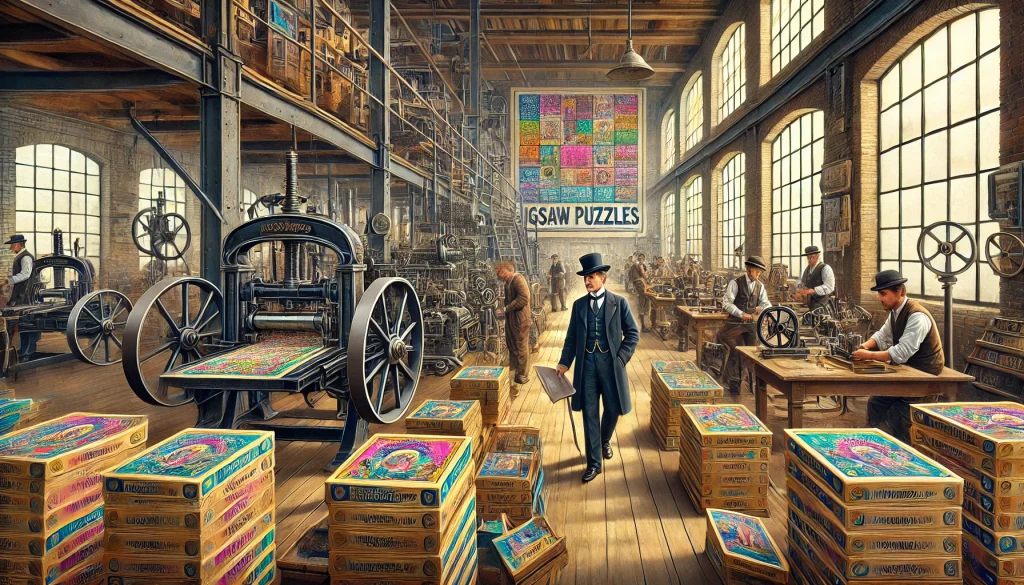
Pre-industrial: single parts
The first puzzles, designed in the 18th century, were often used as educational tools. They represented geographical maps and were used to teach children history and geography. Created by skilled artisans, these puzzles were made of solid wood, each piece cut with the help of saws to sing, hence the term “jigsaw”, which means jumping saw in English.
This artisanal work made each puzzle a unique but costly work. For example, a typical early 19th century puzzle could cost a worker several weeks’ wages, making it inaccessible to the majority of the population.
The arrival of mass production
Industrialisation has changed the situation with two major advances: the mechanization of cutting and the use of more affordable materials. Mechanical saws, introduced in the late 19th century, made it possible to produce puzzles much faster and more cheaply. At the same time, wood was gradually replaced by cardboard, a lightweight, economical and easily printable material.
These innovations made it possible to create serial puzzles. What once required manual work days could now be achieved in a few hours. Production costs have fallen, resulting in lower prices and unprecedented accessibility.
Let us take a concrete example: in the late 1920s, a cardboard puzzle cost about 25 cents in the United States, a fraction of the price of wooden models. This change has caused their popularity to explode among the middle classes.
The 1930s: the golden age of the puzzle
The Great Depression of the 1930s ironically promoted the rise of puzzles. At a time when affordable recreation was scarce, cardboard puzzles have become a welcome distraction for millions of households. Their production peaked with companies like Parker Brothers producing millions of copies a year.
The puzzles were even offered free of charge with certain consumer products, a marketing strategy that strengthened their appeal. For example, cereal brands distributed mini-puzzles in their boxes to attract families.
From crafts to popular culture
The industrialisation has also allowed for a diversification of themes and formats. Puzzles were no longer limited to maps or educational scenes. They could now depict landscapes, famous works of art, or even advertisements. This evolution has strengthened their cultural presence, turning the puzzle into a universal entertainment product.
A notable example of this transition is the reproduction of famous art works, such as those by Van Gogh or Monet, in the form of puzzles. These affordable versions allowed everyone to possess, in a certain form, a masterpiece at home.
A lasting impact
Mass production has not only democratized the puzzle, but it has also solidified its place as a timeless pastime. Even today, puzzles benefit from technological advances inherited from industrialization. Modern machines can cut thousands of pieces with extreme precision, while digital printing provides exceptional quality images.
In addition, industrialisation has paved the way for innovations such as 3D puzzles or personalized puzzles, meeting the expectations of modern enthusiasts while honouring the heritage of the 18th century artisans.
The Commission
The industrialization of the puzzle is a story of innovation and democratization. What was once a luxury reserved for an elite has become a universal leisure activity thanks to advances in mechanization and manufacturers’ imagination. Today, puzzles continue to evolve, but their ability to bring generations together in a simple and engaging activity remains unchanged.


Discuss this articleHave a question or an experience to share?