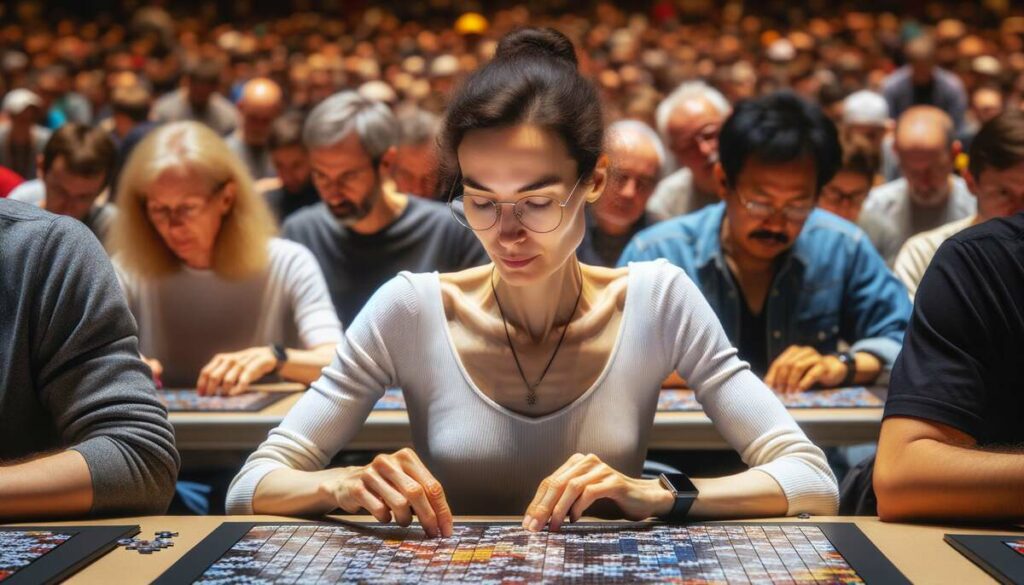
The principle seems simple: discover a puzzle at the time of departure and assemble before the other competitors. But at this level, each second counts. Visual recognition, organization of parts, communication and stress management can make all the difference.
The WJPC 2026 is currently taking place from 16 to 20 September in Valladolid. the WJPC 2026 programme and find out The puzzles of WJPC 2026, which were gradually added after their disclosure.
What is the World Jigsaw Puzzle Championship?
The WJPC is an international competition for speed puzzling organised by the The World Jigsaw Puzzle Federation, or WJPF.
The Federation’s objectives include developing the practice of the speed puzzle, harmonizing regulations and supporting the creation of national federations and championships.
The WJPC is not reserved for a small elite. Experienced champions are alongside amateurs who participate to discover the competition, meet other enthusiasts or simply compete with the timer.
All events are held on the premises.There is no distance participation as the organisation must ensure the same conditions and monitor compliance with the regulations.
The history of the WJPC, year after year
Since its inception, the World Jigsaw Puzzle Championship has grown dramatically:
- The Commission shall adopt implementing acts in accordance with Article 21 of this Regulation. : first edition held in Valladolid, with 531 participants representing 39 countries.
- 2020 and 2021 : competition interrupted due to the global pandemic.
- The Commission shall adopt delegated acts in accordance with Article 21 of this Regulation. The European Championship was resumed with 470 participants from 44 countries.
- The Commission shall adopt delegated acts in accordance with Article 21 of this Regulation. 905 participants and 54 countries represented. The championship is clearly changing.
- The following information shall be provided: : a record at the time, with 1,777 participants from 74 countries. The event confirmed its place in international speed puzzling.
- The following information shall be provided: : fifth edition and the appearance of supplementary rankings for juniors, seniors and beginners.
- The following information shall be provided: The sixth edition, held from 16 to 20 September in a new venue in Valladolid, has attracted more than 2 400 entries from 72 countries.
This progress illustrates the rapid growth of international speed puzzling. The WJPC archives.
How ‘s the WJPC going ?
The exact programme varies from one edition to another, but the championship is mainly based on three categories: individual, pair and team.
Each category may include a first round, one or more qualifying stages and a final.
The individual category
Each participant individually assembles a puzzle, usually made up of 500 pieces.
This test particularly testes the speed of recognition, sorting and the ability to maintain an effective method under pressure. Qualifications can be organized in several groups before the semifinals and the final.
The category of pairs
The pair category brings two people together around the same puzzle.
The first rounds often use 500-piece puzzles, while the final can be contested on a 1,000-piece puzzle. Both partners must coordinate their sorting, naturally divide the image areas and avoid working on the same elements.
The category of teams
Teams are usually made up of three or four people, and depending on the edition and the game, they must assemble one or more 1,000-piece puzzles in a limited time.
Individual speed remains important, but collective organization becomes decisive. Some teams distribute colors or image areas, while others entrust sorting, borders or assembly to specific members.
The additional classifications
Some editions also offer rankings or subcategories for beginners, juniors or different age groups.
These are not necessarily separate tests: these participants can perform the same puzzle and appear in a complementary classification. The categories selected must therefore be checked in the rules of each edition.
How are the competitors ranked?
When a participant completes his puzzle in the allotted time, his ranking is mainly based on his final time.
If the puzzle is not completed at the end of the handle, the organisation will record the properly assembled pieces according to the conditions laid down in the regulation. Penalties may also be applied in case of missing part or infringement.
A judge checks the puzzle and records the result. The participant must therefore ensure that his time and, if necessary, his number of pieces were correctly recorded before leaving the competition area.
What puzzles are used at the WJPC?
The puzzles remain hidden until the start of each round.
Ravensburger is the main partner of the championship and provides the puzzles used in recent editions. The conditions are identical for competitors in the same round, even when the rules allow them to choose between several models.
Contrary to a common idea, not all puzzles used in WJPC are created exclusively for competition. The first rounds can use models already marketed, from a previous season or even already used in another run.
The advanced and final phases are more often used for unpublished or uncommercialised illustrations, so their identity remains secret until the start.
After each championship, we group the models identified in our WJPC puzzle files:
Under the current rules, puzzles handed over during the rounds become the property of the participants at the end of the event.
Find out Ravensburger championship puzzles are available for purchase.
Can we play in the World Puzzle Championship?
The WJPC is accessible to both amateurs and experienced competitors. It is currently not necessary to win a national championship or pass a pre-qualification to register.
It is also possible to participate even if your country does not have a WJPF member organisation.
The current regulation sets the minimum age at 14 years, or for persons who reach this age during the championship year. However, a younger participant can compete in a pair or team if he or she is accompanied by an adult.
The entries are made on the official website of the WJPCTariffs, quotas and deadlines vary by category and edition.
The main registration covers participation and the puzzles used.
As places are limited, it is best to prepare an account and register as soon as bookings are opened.
The main rules to be known
The regulations may change each year, so it is essential to consult their latest version before the championship.
The WJPC’s usual rules include:
- participants must reach the competition area before the start of their round;
- the boxes cannot be opened until official authorisation;
- phones and digital devices cannot be used to enlarge the image;
- additional lights and devices for changing the height of the table shall be prohibited;
- personal cutting tools shall not be used to open the boxes;
- only certain sorting plates are permitted, with limited number and dimensions;
- supports for holding the box cover are generally permitted;
- No outside help can be received during a trial.
The regulations currently allow headphones if they do not disturb other participants and wolves. official rules for the current edition.
How do you prepare for the WJPC?
Participating in a speed puzzle competition asks more than to know how to quickly finish a familiar image. On the day of the test, you must discover an unknown puzzle, work in a shared space and manage the noise and the pressure of the chronometer.
Training with unknown puzzles
Avoid repeating only the puzzles you already know, and vary the illustrations, colors, contrast levels, and difficulties.
500-piece puzzles are particularly suited to individual training.For pairs and teams, regularly add 1000-piece puzzles.
Reproducing the conditions of competition
Use a timepiece and keep a maximum time, work on a surface close to the one available in competition and limit yourself to the permitted accessories.
It is also useful to train without additional lighting, as personal lamps are not allowed in the competition area.
Analysing the sessions
Do not just look at the end times.
- the time spent to turn and sort the pieces;
- areas which have slowed down the assembly;
- classification errors;
- the pieces sought several times;
- The Commission has also adopted a number of measures to combat the use of the ‘recycling’ method.
This analysis helps to determine whether you need to improve your sorting, form recognition or overall organization.
Working on communication
Good communication in pairs and teams avoids unnecessary duplication and displacement.
Practice with the same partners, test different distributions and learn how to change methods when one person finishes his area before the others. An overly rigid strategy can become as penalizing as a total absence of organisation.
For further information, see our tips to improve your time in speed puzzle.
Can we compare the records between editions?
The times at WJPC can be spectacular, but two performances are not always directly comparable.
The difficulty depends on many elements: illustration, cutting, colours, number of homogeneous areas, size and conditions of the handle. A faster time does not automatically mean that the performance was superior.
For this reason, it is best to consult the results in the context of their edition and the puzzle used. Official rankings are published on the WJPF website, while puzzles and events are grouped in our The WJPC archives.
How do you follow the WJPC?
The competitions are usually broadcast on the World Jigsaw Puzzle Federation’s channels and networks.
On The Puzzle Fit, you can find:
- the dates and schedule of the current edition;
- links to official rebroadcasts and results;
- the puzzles revealed during each round;
- the results and main events of the championship;
- the archives of previous editions.
See the page World Jigsaw Puzzle Championship to access all our WJPC content.
Why has the WJPC become a must-have?
The WJPC combines two rarely associated aspects: the concentration of the traditional puzzle and the intensity of a race against the clock.
The competition allows the best specialists to compete internationally, but it is also a great community gathering. Participants, accompanyers and spectators can meet enthusiasts from many countries, discover different methods and witness performances that are difficult to imagine when practicing alone at home.
This opening largely explains the development of the championship since its inception. The WJPC also helps to raise awareness of the speed puzzle and gradually structure this discipline through rules, rankings and national organisations.
Frequently Asked Questions on the WJPC
What does WJPC mean?
WJPC means World Jigsaw Puzzle ChampionshipIt is the main international competition organized by the World Jigsaw Puzzle Federation.
Where is the WJPC going ?
The editions organised since 2019 have been held in Valladolid, Spain.The exact location may change: it must be checked on the relevant edition page.
Do you have to be a champion to be a part of this?
No. No minimum level or prior national qualification is currently required.
What is the minimum age to participate?
The minimum age is 14 years old.Younger participants may participate in the pair or team categories when accompanied by an adult.
Can we participate in the WJPC online?
No, the WJPC is an on-site competition.
Are puzzles known in advance?
No. The puzzles remain hidden until the start of the handle. The first rounds can use commercialized models, while the final phases often offer new puzzles.
Do the participants keep the puzzles?
Under the current rules, puzzles handed over during the rounds become the property of the participants once the test is completed.
Can we attend the WJPC as a spectator?
The public is generally free to enter, but only participants, judges and accredited media can enter the competition area.
Discuss this articleHave a question or an experience to share?