Choosing a visual from series 13
Identify the areas that will help you sort the pieces, and then check which interactive elements accompany the illustration and in which language.
A new way to solve puzzles
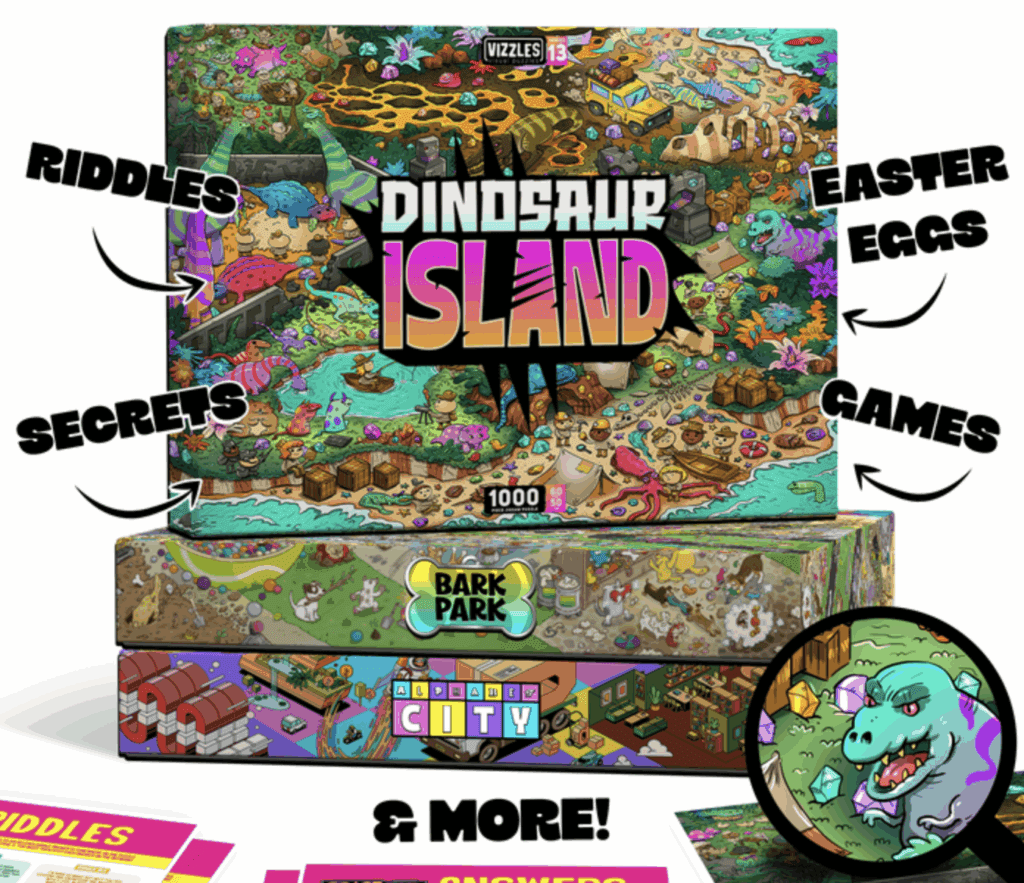
In the ever-saturated landscape of jigsaw puzzles, Vizzles carves a niche for himself. Series 13 is not intended to appeal to lovers of peaceful landscapes or nostalgic deaths. It’s targeting those who want more. No more storytelling. No more gambling. More ambition. The promise: three puzzles on the border between puzzle, board game and visual comic book.
The headlines are already talking: Dinosaur Island, Alphabet City, Bark ParkEach one is a playground full of playgrounds designed by illustrators who think like level designers. Sam MilhamThe newly created Vizzles illustrator, founder and creative brain, has once again pushed the demand further. Liz Orton and Kelsey Robinson isTogether they deliver three worlds that are not just beautiful, they are playful.
Let’s take a look at Dinosaur Island. It’s not just an island populated by dinosaurs. It is a thematic park where each species is placed in a unique habitat, where human characters live on burlesque mini-adventures, where visual details tell of the accident, discovery, panic or routine. This is Jurassic Park drawn with the irony of a Pixar and the meticulousness of a Where’s Waldo under steroids. You put a piece down, you smile. You ask ten, you get a story.
Playing the puzzle after you’ve finished it
Maybe that’s the real twist of this 13th series: The puzzle becomes a game after it’s assembledEvery visual is packed with micro-objects, mini-quests. Alphabet CityYou can search every letter, find pop culture references, find recurring characters in the scenes. It’s a bit like an imaginary city where every building, every advertising sign, every passerby participates in a vast urban narrative.
On the Bark ParkThe tone is lighter, but not less rich. Dozens of different breeds of dogs, each with their own activity, their owners, their own time of glory or shame. One dog steals ice cream, another does yoga, and a third digges a tunnel. It’s alive, funny, and so well-structured that we could almost create a canine fan fiction from the finished puzzle.
This approach changes everything. Unlike a classic puzzle, which is stored once finished (or glued under glass), the Vizzles want to stay on it, as we explore a giant map in an open-world. We invite friends to watch, play, interact. And it ‘s no coincidence , this series was conceived As a social game as much as an artistic object.
Material quality, independent production and author ambition
At a time when many crowdfunding puzzles are produced on the channel with a last-minute design subcontracted, Vizzles plays transparency and consistency. Each illustration requires more than 200 hours of workThe puzzles are printed on a matt double layer paper, mounted on a thick cardboard, with a precise and durable cut. The format remains in 1000 pieces — demanding but accessible — and the boxes are designed with UV spot finish, for a high-end rendering.
There’s no over-promise. The Vizzles team is three people.They do everything themselves, from DA to logistics. Yet, the previous Kickstarter campaigns have all been delivered in time. Series 13 will not derogate from this craft logic but rigorous: the stock is planned, the print already launched, the distribution managed with Great Games.
On the price side, the early bird offers a puzzle at about 27 €, with degressive wearing costs depending on the number of boxes. The usual backers never take a single puzzle, and for reason: the visuals work like a triptych. The temptation to collect is almost inevitable.
Why Vizzles is on the sidelines
The puzzle has become cool in recent years, but few brands actually dig into the narrative, immersive or playful aspect. Vizzles does this with consistency, demand and respect for the player. Where many simply surf on illustrative trends or copy Instagram aesthetics, this Australian brand digs a unique trail, between visual art, narrative play and experience design.
And this 13 Series is probably the most successful to date. Not just for its visuals. Not just for the quality of the material. But because it understands something that few puzzle editors have integrated: The puzzle is not just a lonely pastimeIt is a medium of narrative, play, collective interpretation, an object that is explored, that is told, that is inhabited.
With Vizzles, we’re not just putting together, we’re living in the puzzle.
Discuss this articleHave a question or an experience to share?