It’s not just a matter of translation. It’s a matter of looking: do you see in the puzzle a pedagogical tool, visual meditation, mental challenge or a moment of patience? The vocabulary gives us valuable clues about the place of the jigsaw puzzle in the collective imagination.
The puzzle, an object that crosses languages
Before we go into the words, a historical reminder is necessary. The puzzle was born in England in the 18th century, in the form of wooden geographical maps, cut by hand using a jump saw The jigsawToday, the pre-cut cardboard puzzle has become the norm, but the term origin remains in use in the English-speaking world.
But in other languages? Things are complicated or poetic. main translations of jigsaw puzzleThe Commission’s proposal for a directive on the protection of workers’ rights and the right to a fair trial is based on the principle of equal treatment.
How do you say jigsaw puzzle in the world?
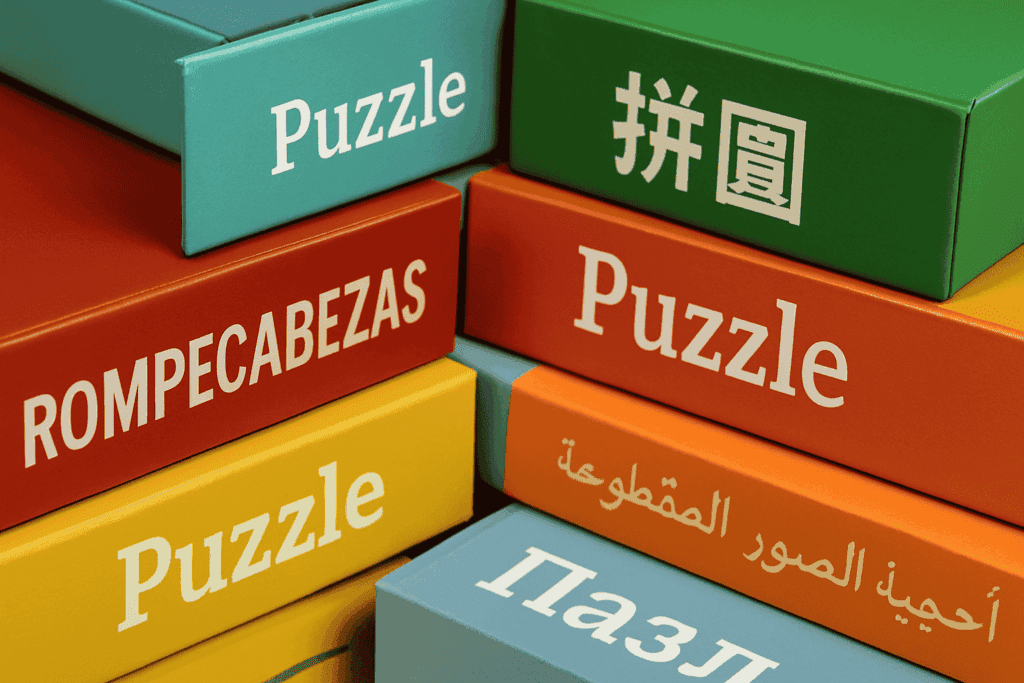
- French ⁇ puzzle The English word was adopted as it is in common use. It was once referred to as a head-crack, but it is now reserved for logical or mechanical games. Today,
- Spanish ⁇ rompecabezas : Literally, which breaks the head. It’s a strong image, which suggests that the puzzle is a mental test. Yet, this term is used for all types of puzzles, whether they are in images or logical. In Spain as in Latin America, Other This is a good indication of the intensity with which this activity is lived.
- German ⁇ Puzzle The word is also used here. However, sometimes terms such as The picture puzzle (puzzle d’image) or Legespel (g) in educational contexts. German likes precision, and the language often uses descriptive compounds to designate variants.
- Italian ⁇ puzzle Similar case: English took over. breaking up (similar to the French puzzle) exists, but it mainly refers to abstract or logical puzzles. A puzzleI just…
- Dutch ⁇ legpuzzel : Literal translation: ⁇ puzzle to ask ⁇ . Laying (putting, assembling) with puzzleA great way to highlight the central gesture of the game: laying down the right pieces, one by one, until the image is revealed.
- Japanese ⁇ パズル (pazuru) It is a simple transliteration of the English word puzzleHowever, in shops or on boxes, it is sometimes found ジグソーパズル (The name of the gameJapan, which values concentration and detail, has made this activity a refined art. plastic puzzles, transparent, wood, 3D, or clamp assembly.
- Chinese ⁇ 拼图 (pīntú) ⁇ ⁇ ⁇ ⁇ ⁇ ⁇ ⁇ ⁇ ⁇ ⁇ ⁇ ⁇ ⁇ ⁇ ⁇ ⁇ ⁇ ⁇ ⁇ ⁇ ⁇ ⁇ ⁇ ⁇ ⁇ ⁇ ⁇ ⁇ ⁇ ⁇ ⁇ ⁇ ⁇ ⁇ ⁇ ⁇ ⁇ ⁇ ⁇ ⁇ ⁇ ⁇ ⁇ ⁇I ‘m not going toThe term is purely functional, without any emotional connotation.
- Russian ⁇ Pazl (pazl) Another transliteration of the English word.the golovolomkaThe term “reflective games” is used to refer to games of thought in general. peace That’s the word for jigsaw puzzles.
- Arabic ⁇ أحجية الصور المقطوعة (uhjiyat al-suwar al-maqtuʿa) : literal translation of ⁇ puzzle of cut images ⁇ . The expression is long but precise. puzzle in its English version.
Words shape experience
Why do these differences matter? Because they influence the way we play. To say “crap” or “crap” is not neutral: it is to present the puzzle as a mental battle. To say ⁇ image to gather ⁇ or ⁇ play patience ⁇ is a completely different approach: more gentle, more contemplative. The word conditioning is waiting. He shapes the atmosphere around the game.
In countries where the word evokes effort or difficulty, complex puzzles with monochrome parts or deceptive shapes find an informed audience. Where the word is neutral or aesthetic, artistic, decorative, or meditative puzzles are more popular. Language acts here like a magnifying glass: it reveals game cultures, ways of thinking.
So the next time you open a box of 1,000 pieces, ask yourself: in your head, are you doing a puzzle… or are you facing one? Other ?
Discuss this articleHave a question or an experience to share?